


JEE Advanced 2026 Exam Pattern: Check Paper 1 & 2 Pattern, Marking Scheme & Total Marks
JEE Advanced 2026 will be conducted by IIT Roorkee on May 17, 2026, which is on Sunday. The exam will be conducted in the computer-based test (CBT) mode with two compulsory papers – Paper 1 and Paper 2. Each paper carries 180 marks, combining Physics, Chemistry, and Mathematics sections, which total to 360 marks. The JEE Advanced paper has four different question types, each with its own marking criteria, partial marking rules, and negative marking conditions. Due to the unpredictable nature of the paper pattern, students are advised to read the exam instructions carefully before attempting the paper.
For a successful JEE Advanced preparation strategy, a student needs to understand the exam pattern. In this blog, find detailed information about the JEE Advanced paper pattern, total marks, marking scheme, and subject-wise distribution of the questions in both Paper 1 and Paper 2. Hence, this blog provides an explanation by Matrix experts on every aspect of the JEE Advanced 2026 exam pattern.

JEE Advanced 2026 Exam Pattern Overview
The JEE Advanced 2026 conducting body is IIT Roorkee. 2.5 lakh students will be appearing in the world’s second toughest exam this year, competing for 20,000 seats in the IITs of India. It will be conducted in two papers – Paper 1 and Paper 2. The JEE Advanced exam has tricky questions asked from the JEE Advanced Syllabus that test deep conceptual understanding, conceptual passages reading ability, numerical calculations ability, and application based understanding. Here are the exam highlights of the exam:
- Both Paper 1 and Paper 2 are of 3 hours duration (180 minutes) each.
- The total marks of the paper are 360, where 180 marks are for each paper. The total marks per subject are 60 marks.
- There will be three subjects in both papers, just like JEE Main – physics, chemistry, and mathematics. Check major Difference between JEE Main and JEE Advanced 2026 for more information.
- The question types in the JEE Advanced 2026 paper are Single Correct MCQ, Multiple Select (MSQ), Integer Answer, and Match the following.
- Since 2021, numerical passage questions have also been a part of the JEE Advanced paper pattern.
- The total number of questions for both papers totals 102 (approximately). Hence, there are approximately 51 questions for each paper.
- Negative marking varies depending on the question type and is not fixed.
- The paper will be conducted in both Hindi and English.
Check the complete JEE Advanced 2026 eligibility criteria and find out if you meet all the criteria requirements, including age limit, attempt limit, and qualifying marks.
JEE Advanced 2026 Paper Pattern – Paper 1
Paper 1 of JEE Advanced Paper 1 is scheduled from 9:00 AM to 12:00 PM. It has three subjects – physics, chemistry, and mathematics. The JEE Advanced paper pattern or structure is designed to test students’ conceptual clarity under pressure. For this reason, the exam pattern is not defined, and there are multiple types of questions, with each having its own marking scheme. In Paper 1, there are MSQs, which means that there is more than one correct answer in one MCQ. Each subject has 4 sections –
- Section I: Single Correct Question
- Section II: Multiple Correct Question
- Section III: Non-negative Integer
- Section IV: Column Type Question
The table below showcases the clear JEE Advanced 2026 exam pattern of Paper 1 with the number of questions and maximum marks per subject.
| Section | Subject | Question Type | No. of Questions | Max Marks per Subject |
| Section 1 | Physics | Single Correct MCQ | 4 | 12 |
| Section 2 | Physics | Multiple Select (MSQ) | 3 | 12 |
| Section 3 | Physics | Integer Answer | 6 | 18 |
| Section 1 | Chemistry | Single Correct MCQ | 4 | 12 |
| Section 2 | Chemistry | Multiple Select (MSQ) | 3 | 12 |
| Section 3 | Chemistry | Integer Answer | 6 | 18 |
| Section 1 | Mathematics | Single Correct MCQ | 4 | 12 |
| Section 2 | Mathematics | Multiple Select (MSQ) | 3 | 12 |
| Section 3 | Mathematics | Integer Answer | 6 | 18 |
| Paper 1 Total | – | – | 48 questions | 180 marks |

Types of Questions in JEE Advanced 2026 Paper 1
The table below represents the type of questions students can expect in the JEE Advanced 2026 Paper 1 exam.
| Question Type | How It Works |
| Single Correct MCQ | 4 options where exactly one is correct |
| Multiple Select (MSQ) | 4 options where one or more of which are correct |
| Integer Answer (0–9) | Type a single-digit integer as the answer between 0 and 9 |
| Column Match Type Questions | Matching the right options in both columns by eliminating options. |
| Passage Type Comprehension Question | A single passage with a scenario and experimental setups, which is followed by 2 or more multiple-choice questions. |
JEE Advanced 2026 Paper Pattern – Paper 2
The JEE Advanced 2026 Paper 2 exam is conducted from 2:30 PM to 5:30 PM on 17th May, 2026. Paper 2 has three subjects – Physics, Chemistry, and Mathematics. However, paper 2 is said to be more difficult and unpredictable compared to Paper 1. Paper 2 is expected to have more integer-type and application-based questions, whereas Paper 1 has more direct MCQs. Hence, Paper 2 will be more challenging in terms of adaptability and time management. This paper is designed to evaluate not just conceptual clarity but also the ability to interpret data, connect multiple concepts, and solve problems under varying formats.
| Section | Subject | Question Type | No. of Questions | Max Marks per Subject |
| Section 1 | Physics | Single Correct MCQ | 4 | 12 |
| Section 2 | Physics | Match the List | 3 | 9 |
| Section 3 | Physics | Integer Answer (0–9) | 6 | 18 |
| Section 1 | Chemistry | Single Correct MCQ | 4 | 12 |
| Section 2 | Chemistry | Match the List | 3 | 9 |
| Section 3 | Chemistry | Integer Answer (0–9) | 6 | 18 |
| Section 1 | Mathematics | Single Correct MCQ | 4 | 12 |
| Section 2 | Mathematics | Match the List | 3 | 9 |
| Section 3 | Mathematics | Integer Answer (0–9) | 6 | 18 |
| Paper 2 Total | 48 questions | 180 marks |
Types of Questions in Paper 2
In both Papers 1 and 2, it is not fixed that all types of questions will appear in both papers. For example, Paper 1 might have all MCQs, and Paper 2 might have a mix of both MCQs and MSQs. The table below represents all the types of questions that are expected to be present in Paper 2 of JEE Advanced 2026:
| Question Type | How It Works |
| Single Correct MCQ | 4 options where exactly one is correct |
| Multiple Select (MSQ) | 4 options where one or more of which are correct |
| Integer Answer (0–9) | Type a single-digit integer as the answer between 0 and 9 |
| Column-Type Match the Following Questions | Matching the right options in both columns by eliminating options. |
| Passage Type Comprehension Question | A single passage with a scenario and experimental setups, which is followed by 2 or more multiple-choice questions. |
JEE Advanced 2026 Marking Scheme
The JEE Advanced 2026 marking scheme is what makes the exam more challenging and sets it apart. The marking scheme differs based on the type of question and is not definite throughout the paper, as it is in the JEE Main exam. This section has a detailed marking scheme as per the question type for both papers of the JEE Advanced exam.
Important note for 2026: Students should note that IIT Roorkee will disclose the exact marking scheme on the exam day in the instructions to candidates section. The section-wise breakdown shown on this page is based on JEE Advanced 2024 and 2025 actual question papers.
Marking Scheme for Single Correct MCQ
For MCQs with one single correct answer, candidates will be allotted 3 marks for the correct option and -1 for the incorrect option. Check the marking scheme in the table below:
| Scenario | Marks Awarded |
| Correct option selected | +3 |
| Incorrect option selected | -1 |
| No option selected (unattempted) | 0 |
| More than one option selected | -1 |
Marking Scheme for Multiple Select Questions (MSQ)
Partial marking is allotted for multiple correct questions. But the rule is that partial marking is allotted only if all the options chosen are correct and there is no wrong option. For example, if an MCQ has 3 correct options, and the student has marked 2 correct options and one incorrect, they will not be allotted partial marks. But if the student had marked only 2 correct options, they would be given partial marks. Check the marking scheme for multiple-correct-answer MCQs in the table below:
| Scenario | Marks Awarded |
| All correct options selected; no incorrect option selected | +4 |
| Only some correct options selected, no incorrect ones. | +1 per correct option selected |
| Any incorrect option selected (regardless of the correct ones also selected) | -2 |
| No option selected (unattempted) | 0 |
Since the marking scheme of multiple-correct-answer questions is tricky to understand, here is a table explaining in detail how partial marks are allotted. The table is made by Matrix JEE experts for easy understanding of the marking scheme:
| What You Select | Marks You Get | Rule |
| A, B, D | +4 | All three are correct; there is no wrong option |
| A, B | +2 | Two correct, no wrong option – partial credit |
| A only | +1 | One correct, no wrong option – partial credit |
| D only | +1 | One correct, no wrong option – partial credit |
| A, B, C | -2 | C is wrong – any wrong option triggers -2 regardless |
| A, B, D, C | -2 | C is wrong, even though A, B, and D are all correct |
| C only | -2 | Wrong option selected |
| B, C | -2 | C is wrong |
| Nothing selected | 0 | Unattempted |
Marking Scheme for Integer Answer Type
In both papers, the integer-type questions have no negative marking and are a scoring section where students can attempt all 6 questions without worrying about marking being deducted.
| Scenario | Marks Awarded |
| Correct integer entered | +3 |
| Incorrect integer entered | 0 |
| No answer entered (unattempted) | 0 |
Marking Scheme for Match-The-Column Questions
If we look at past year trends, ‘Match the Column’ questions are on the easier side and quite doable. Sometimes, not all the options are to be matched and can be eliminated. The table below shows the marking scheme for match-the-column questions.
| Scenario | Marks Awarded |
| Correct combination selected | +3 |
| Incorrect combination selected | -1 (no negative marking in paper 2) |
| No option selected (unattempted) | 0 |
JEE Advanced 2026 Total Marks – Paper 1 & Paper 2
The total marks of the JEE Advanced 2026 are 360 marks, combining both Paper 1 and Paper 2. Students will be evaluated out of 360 marks, and attempting both papers is mandatory. The total marks of Paper 1 and Paper 2 papers are individually of 180 marks. The three subjects or sub-sections of the paper, which are Physics, Chemistry, and Mathematics carry equal weightage, with each subject contributing 60 marks per paper and 120 marks across both papers combined.
Subject-wise Marks & Total Marks in Paper 1
The table below showcases the total marks and subject-wise total questions and marks distribution of Paper 1 of JEE Advanced, 2026. The table below is based on the actual JEE Advanced 2026 paper, where the total number of questions is 48, and the total marks are 180.
| Subject | Total Questions | Total Marks | Share of Paper 1 |
| Physics | 16 | 60 | 33.3% |
| Chemistry | 16 | 60 | 33.3% |
| Mathematics | 16 | 60 | 33.3% |
| Paper 1 Total | 48 | 180 | 100% |
Subject-Wise Marks & Total Marks in in Paper 2
The table below has total marks, subject-wise marks, and the total number of questions in JEE Advanced 2026 exam:
| Subject | Total Questions | Total Marks | Share of Paper 2 |
| Physics | 16 | 60 | 33.3% |
| Chemistry | 16 | 60 | 33.3% |
| Mathematics | 16 | 60 | 33.3% |
| Paper 2 Total | 48 | 180 | 100% |
For each paper, the time duration is 3 hours or 180 minutes. Considering the total number of questions, the average time to attempt one question is approximately 3.75 minutes.
JEE Advanced 2026 Bonus Marks
After the JEE Advanced 2026 exam, bonus marks are awarded under specific conditions.
These conditions are if any of the questions in both Paper 1 and Paper 2 are incorrect, ambiguous, or dropped. We will see in detail what these terms mean, and we will also look at the past year’s trends of bonus marks allotted in the JEE Advanced 2026 exam from 2022 to 2025. The table below showcases how many bonus marks are allotted in each year:
- Incorrect: If a question is found to be incorrect, then all students who appeared for the paper will be allotted the bonus marks even if the question was not attempted. Incorrect questions include questions with factual errors, wrong data, or misprinted questions.
- Ambiguous: If a question has no correct option or has multiple correct answers with no clarity, then it is considered ambiguous and given full bonus marks.
- Dropped: If a question is invalid due to no correct options or mistakes, the question is dropped, and full marks for the question are given to all students who gave the paper.
The bonus marks are added to every candidate’s score automatically before the final rank list is prepared. Bonus marks have been awarded every year from 2022 to 2025, making it a consistent pattern rather than a rare exception. The range has been 3 to 10 marks. While you cannot plan or prepare for bonus marks, always attempt every paper fully. Bonus marks are awarded to all candidates who appeared, so an absent candidate gets nothing, even if a question is dropped.
| Year | Conducting IIT | Subjects | Questions Dropped | Bonus Marks Awarded |
| 2025 | IIT Kanpur | Physics | 1 | 3 marks |
| 2024 | IIT Madras | Chemistry (Paper-2) | 1 | 4 marks |
| 2023 | IIT Guwahati | Physics (Paper-2) | 2 | 6 marks (3 each) |
| 2022 | IIT Bombay | Physics | 3 | 10 marks |
Has the JEE Advanced Paper Pattern Changed? (Past Year Trends)
For 2026, IIT Roorkee has officially clarified that there will be no major changes for JEE Advanced 2026. The paper pattern change directly affects your JEE Advanced preparation strategy. The most asked query is whether the JEE Advanced 2026 paper pattern has changed or not. The JEE Advanced exam is designed in a way that the paper pattern is a little vague, and it changes slightly every year. The exact paper pattern and marking scheme are revealed on the exam day itself. The conducting of IIT rotates annually, and each institute can keep the number of questions, section structure, marks distribution, and other factors as they like. In the exam pattern of JEE Advanced, the only constant is the total marks, which is 360, and the three subject sections. The table below shows JEE Advanced 2026 exam pattern trends.
| Parameter | JEE Advanced 2024 | JEE Advanced 2025 | JEE Advanced 2026 (Expected) |
| Conducting IIT | IIT Madras | IIT Kanpur | IIT Roorkee |
| JEE Advanced Exam Date | May 26, 2024 | May 18, 2025 | May 17, 2026 |
| Total Papers | 2 | 2 | 2 |
| Total Marks | 360 | 360 | 360 (expected) |
| Marks per Paper | 180 | 180 | 180 (expected) |
| Total Questions (Both Papers) | 96 | 96 | 108 (expected) |
| Questions per Paper | 48 | 48 | 54 (expected) |
| Questions per Subject per Paper | 16 | 16 | 18 (expected) |
| Sections per Subject (Paper 1) | 4 | 4 | 4 (expected) |
| Sections per Subject (Paper 2) | 4 | 3 | 3–4 (expected) |
| Subjects | Physics, Chemistry, Maths | Physics, Chemistry, Maths | Physics, Chemistry, Maths |
| Question Types | MCQ, MSQ, Integer, Match | MCQ, MSQ, Integer, Match | MCQ, MSQ, Integer, Match |
| Negative Marking | Yes, it varies by section | Yes, it varies by section | Yes, it varies by section |
| Exam Mode | CBT | CBT | CBT |
| Duration per Paper | 3 hours | 3 hours | 3 hours |
| Medium | English, Hindi | English, Hindi | English, Hindi |
| Marking Scheme Pre-disclosed | No — revealed on exam day | No — revealed on exam day | No — revealed on exam day |
Ideal JEE Advanced 2026 Attempt Strategy to Increase Score
One of the most crucial factors is the attempt strategy in the JEE Advanced exam. The right strategy helps prevent exhaustion during the exam and improve chances of scoring better. The JEE Advanced 2026 attempt strategy provided below is thoughtfully curated by Matrix JEE experts based on years of experience.
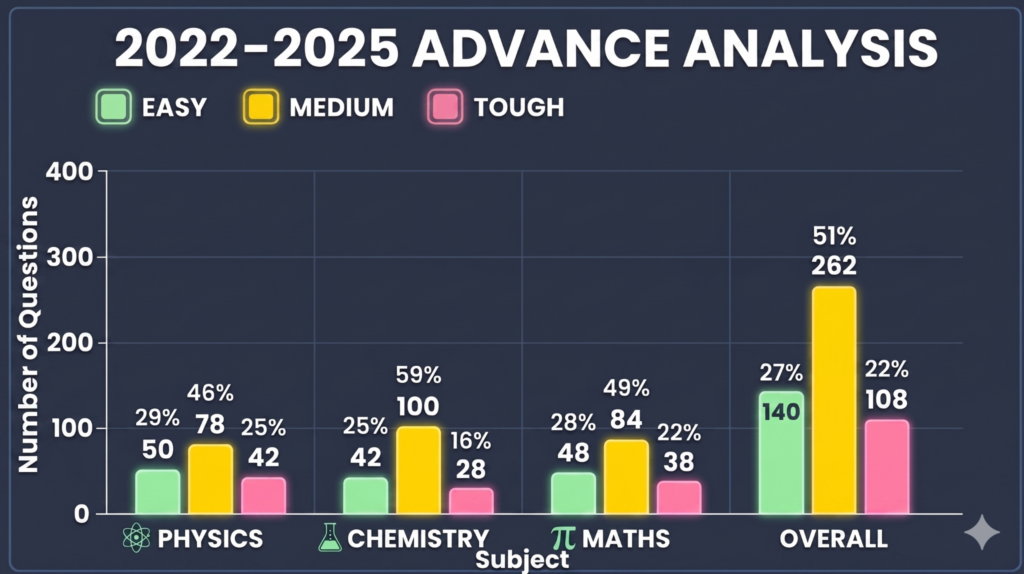
The image shows an exam difficulty analysis done by Matrix experts of the JEE Advanced exam from 2022 to 2025 – the number of questions with the percentage of the paper that is easy, medium, and tough. Students can get an idea of what to expect in JEE Advanced 2026 exam and how to attempt it. Follow the sequence of attempting the questions provided below to increase your score and perform your best on the exam day:
- Start the paper with integer-type questions of all three subjects. Based on previous year trends, integer-type questions have been doable even in the toughest papers, like JEE Advanced 2022. This will create a sufficient base.
- Next, solve the MCQs with single correct options. Solve all the doable questions across three subjects.
- Attempt the passage-type questions, as they are time-consuming, but also students will not feel pressure because they have already attempted the integer questions and MCQs by now, and have ample time to read the passage questions.
- At this point, it is normal for students to feel stressed and exhausted. And this is when students should attempt to match the column, as it is the most doable section and requires the pure elimination method.
- Lastly, attempt the MSQs, which are multiple-select questions. The mind gets the break it needs, and now students can calmly attempt MSQs, as it is time-consuming.
Matrix Expert Insights: Students are advised to target a score of 250+ marks out of 360 in the JEE Advanced 2026 exam to secure a seat in top IIT branches in the CSE branch.
Conclusion
The JEE Advanced 2026 exam pattern has not changed and stays the same as in past years since 2021. For every student who is appearing for JEE Advanced 2026, it is advised to be aware of the exam pattern and marking scheme. There are two compulsory papers – Paper 1 and Paper 2. The question types are MCQs, MSQs, passage questions, match the following, and integer-type questions. The marking scheme is designed to reward accuracy and strategic thinking, eliminating reckless attempts. The 360 marks are distributed equally across Physics, Chemistry, and Mathematics. Use the attempt strategy built by experts, a detailed marking scheme, and exam pattern information to build a reliable JEE Advanced preparation strategy.
Also Read:
FAQs
JEE Advanced 2026 has a total of approximately 102 questions, combining both papers. Each paper has around 48 questions, with 17 questions per subject across Physics, Chemistry, and Mathematics.
The total marks for JEE Advanced 2026 are 360, and this has been consistently the same in the past years. The total marks for each paper are 180, where the subject-wise marks distribution is 60 marks each for Physics, Chemistry, and Mathematics.
Yes, but negative marking depends on the type of question, and it is not uniform across all sections. There is negative marking in single-correct-option MCQs, multiple-correct-option questions, and match-the-column in Paper 1 (no negative marking in Paper 2).
Partial marking is only applied to the multiple-select questions (MSQ) where one or more options are correct. +3 marks are given if all four options are correct, but only three correct options are chosen. Likewise, +2 marks are given if three or more options are correct but only two correct options are chosen and +1 if two or more options are correct but only one correct option is chosen. No partial marks are allotted if one wrong option is chosen and the other options chosen are correct.
The only difference between JEE Advanced 2026 Paper 1 and Paper 2 is the difficulty level. Paper 2 also has paragraph-based questions, which makes it tougher than Paper 1. The marking scheme and question distribution are otherwise identical across both papers.
Students are supposed to attempt both papers, and then only the exam will be considered as successfully attempted. If a student only attempts one paper, then they will not receive any rank and will be considered ineligible for evaluation.
Yes, candidates can choose between English and Hindi as the medium of language to attempt the question paper. During JEE Advanced 2026 Registration, students can choose the language they want to take the exam in. In the event of any discrepancy between the Hindi and English versions of a question, the English version is treated as final.
No, IIT Roorkee has officially clarified that there will be no major changes for JEE Advanced 2026. Initially, there were chances that the 2026 paper would include adaptive testing, but the format remains the same now.
JEE Advanced 2026 includes a mix of Multiple Choice Questions (MCQs) with a single correct answer, Multiple Select Questions (MSQs) with one or more correct answers, and Numerical Answer Type (NAT) questions. Match-the-column or comprehension-based questions are also asked in some sections. Each question type has its own distinct marking scheme with different rules for full marks, partial marks, and negative marking.