


JEE Advanced 2026 Last 10 Days Revision Strategy: Subject-Wise Tips
The JEE Advanced 2026 has been scheduled for May 17, 2026, and there are 10 days left for students to improve their preparation strategy. The question is, can we improve the score in 10 days? The answer is yes, it is possible. In this 10-day time period, students can focus on improving the topics they already know instead of starting new topics. With precision and the right strategy, these 10 days can be a game-changer as they will definitely determine your exam-day performance.
Matrix JEE experts have created this blog to help students apply the right strategy to maximise their score in the last 10 days. Find the 10 expert-backed JEE Advanced 2026 preparation tips and revision strategies for physics, chemistry, and mathematics. These tips will help students push their scores to clear the cut-off and increase their chances of securing an IIT admission seat.

JEE Advanced 2026 Top 10 Chapters – Identifying Weak and Strong Areas
The first step to take before starting a new revision or preparation strategy in the last 10 days is to identify the weak and strong areas. The idea is to revise and not relearn. Take out the complete JEE Advanced 2026 syllabus and divide all topics into three categories – strong, weak, and doable.
The next step is to find out the high-weightage topics in each subject. Students can refer to the table below for subject-wise JEE Advanced 2026 high-weightage topics.
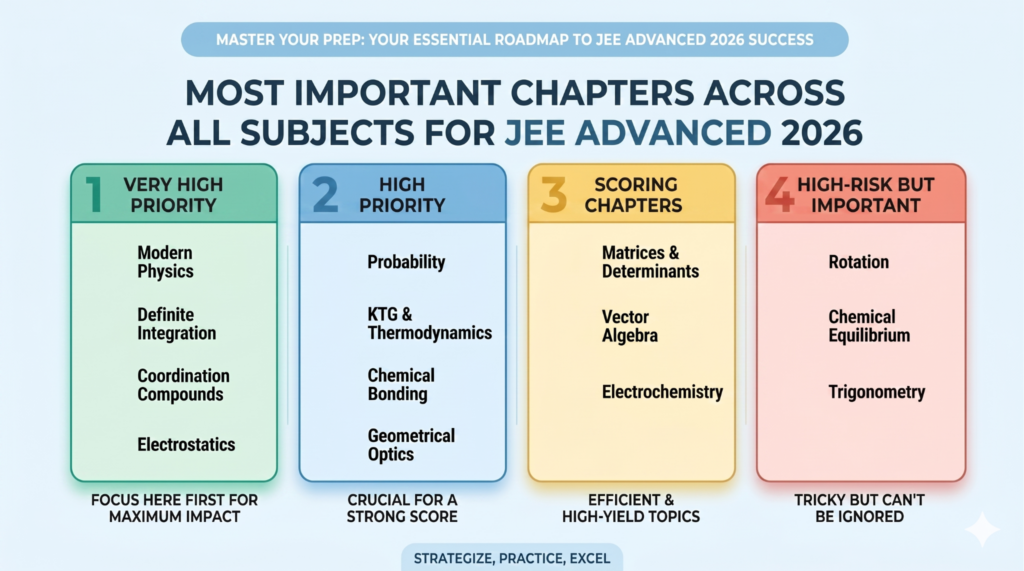
JEE Advanced 2026 Physics High-Weightage Chapters
From the weak and doable category, pick out the chapters with high weightage and put them in the priority category. The goal is to now focus on strong areas and high-weightage chapters.
| Physics Chapter | Avg. Weightage (%) | Highest Weightage Seen |
| Electrostatics | 8–10% | 14% |
| Geometrical Optics | 8–9% | 13% |
| Modern Physics | 11–13% | 19% |
| Current Electricity | 3–5% | 9% |
| Rotation | 6–8% | 14% |
| Capacitance | 5–6% | 14% |
| KTG & Thermodynamics | 7–9% | 14% |
| SHM & Waves | 6–8% | 12% |
| Magnetic Field | 4–6% | 16% |
| Gravitation | 2–4% | 6% |
JEE Advanced 2026 Mathematics High-Weightage Chapters
The high-weightage chapters that you should avoid skipping are matrices & determinants, trigonometry, probability, definite integration, and vector algebra.
| Mathematics Chapter | Avg. Weightage (%) | Highest Weightage Seen |
| Matrices & Determinants | 8–10% | 12% |
| Trigonometry | 7–8% | 11% |
| Probability | 8–10% | 14% |
| Complex Numbers | 5–7% | 9% |
| Vector Algebra | 6–8% | 11% |
| Definite Integration | 9–11% | 16% |
| Application of Derivatives | 4–6% | 7% |
| Permutation & Combination | 3–5% | 6% |
| Circle | 3–5% | 8% |
| Fundamentals of Mathematics | 1–3% | 3% |
JEE Advanced 2026 Chemistry High-Weightage Chapters
The high-weightage chapters to prioritise are aromatic compounds, coordination compounds, p-block elements, chemical bonding, and chemical & ionic equilibrium.
| Chemistry Chapter | Avg. Weightage (%) | Highest Weightage Seen |
| Aromatic Compounds | 7–8% | 10% |
| P-Block Elements | 7–9% | 10% |
| Coordination Compounds | 6–8% | 14% |
| Electrochemistry | 4–6% | 8% |
| Metallurgy | 2–3% | 6% |
| Chemical & Ionic Equilibrium | 4–6% | 9% |
| Chemical Bonding | 6–8% | 18% |
| Chemical Kinetics | 4–5% | 7% |
| Solid State | 2–3% | 3% |
| Thermodynamics | 4–6% | 9% |
With 10 days left for JEE Advanced, the first step is to bring clarity on what to study and what to avoid. Focus on high-weightage chapters and strong areas only. Because of time constraints, students can avoid weak topics of low-weightage and focus on doable topics of low-weightage.
Time Allocation for Study and Revision
In the last 10 days, the JEE Advanced revision strategy should involve a subject-wise study approach that is tried and tested by toppers. Once you have sorted out what chapters to focus on, the next step is to build a strategy to study and revise them. Allocate time daily for each subject:

- Dedicate 65% of the study hours to revision and solving advanced-level problems.
- 25% of the study hours can be dedicated to your strong areas or chapters that are of medium-weightage or low-weightage.
- 10% of the time should be dedicated to only glancing through low-weightage chapters. Just go through the important formulas and derivations.
The most common mistakes observed by Matrix JEE experts are that students fail to manage time during the last 10 days. Students have 240 hours in 10 days, and the goal should be maximum utilisation of the time. Here is a timetable recommended by Matrix JEE experts that students can refer to:
| Time Slot | Activity | Focus |
| 07:00 – 08:30 | Morning Warm-up | Revision of Inorganic Chemistry/Formulae (High retention time) |
| 09:00 – 12:00 | Session 1 | Mock Test or Intense Problem Solving (Physics/Maths) |
| 12:00 – 14:00 | Lunch & Rest | A power nap or light music to reset the brain |
| 14:30 – 17:30 | Session 2 | Mock Test or Subject Revision (Match exam stamina) |
| 18:00 – 20:00 | Analysis/Repair | Fix errors from the morning sessions |
| 21:00 – 22:30 | Light Review | Organic Chemistry mechanisms or Coordinate Geometry results |
JEE Advanced 2026 Physics Revision Strategy
Revising physics formulas is equally important as revising the reasoning behind every formula. To help students revise for JEE Advanced 2026 physics, here is a topic-wise strategy for students by Matrix experts:
- For Mechanics (Rotational, Simple Harmonic Motion, Fluids): the conservation law or constraint equations are very important to solve mechanics problems. Revise chapter-wise by solving advanced-level mechanics problems, and keep the approach of what is being conserved here and what constraints link the variables.
- Rotational Mechanics: Revise the rolling condition and torque equation from scratch until you get a hold of the reasoning behind it until you can reconstruct the formula under pressure. Make sure to practise 5 multi-body system questions where free-body diagrams are involved for every object.
- Electrostatics and EMI: Solve problems involving energy methods to find potential and work done. Get a good grasp on Gauss’s law problems, resolving non-trivial geometries, infinite sheets, spherical shells, and non-uniform charge distribution problems.
- Optics: Revise these topics from scratch – ray optics (lens/mirror combinations), wave optics (YDSE with modifications like slabs and different mediums), photoelectric effect, atomic spectra (hydrogen series), and nuclear decay. Practice paragraph-based questions involving all these concepts together and learn the energy level diagram of hydrogen cold thoroughly.
JEE Advanced 2026 Chemistry Revision Strategy
Chemistry is the easiest scoring subject compared to mathematics and physics in the JEE Advanced exam for the past 6-7 years. Students can utilise this opportunity to revise strategically and make sure they get maximum marks in chemistry. Despite chemistry being an easy-scoring subject, most students end up making silly mistakes easily. Here is a topic-wise JEE Advanced 2026 chemistry strategy that students can follow in the last 10 days:
Physical Chemistry
- Thermodynamics & Equilibrium: The non-negotiable topics in thermodynamics are Gibbs free energy, entropy calculations, and their applications. For the equilibrium chapter, focus on Le Chatelier’s principle with quantitative problems and practice advanced-level buffer solution and solubility product numerics.
- Electrochemistry: The approach for electrochemistry is to memorise standard electrode potentials for common half-cells, understand Nernst equation applications for concentration cells and revise electrolysis calculations (Faraday’s laws).
Chemical Kinetics: Focus on integrated rate laws and their graphical representations, practice problems involving parallel and sequential reactions and regularly revise the Arrhenius equation and temperature dependence.
Organic Chemistry
- General Organic Chemistry (GOC): Revise stability orders (carbocations, carbanions, and free radicals), master topics like resonance and hyperconjugation, and solve inductive effect applications. Dedicate half an hour every day to practising acidity and basicity comparison problems.
- Named Reactions & Mechanisms: The best way to revise reactions and mechanisms is to create a one-page revision card with all named reactions (Aldol, Cannizzaro, Claisen, etc.) and for each reaction learn the mechanism, conditions, and possible variations.
- Aldehydes, Ketones & Carboxylic Acids: Revise nucleophilic addition mechanisms thoroughly, reactivity differences between aldehydes and ketones and practice distinguishing tests and their chemistry.
Inorganic Chemistry
- Coordination Compounds: Memorise IUPAC nomenclature rules, VBT, CFT, and their application, and do not forget to revise their colour, magnetic properties, and isomerism.
- P-Block Elements: To revise the p-block, toppers usually create a reaction chart for each group showing interconversions and structures of common compounds.
JEE Advanced 2026 Mathematics Revision Strategy
Mathematics is where most students either gain or lose their rank in JEE Advanced. Unlike physics and chemistry, it demands speed, accuracy, and the ability to navigate multi-step problems under time pressure. Every revision session in the last 10 days must involve active problem-solving. Use topic-wise PYQs immediately after revising each chapter, time every problem at 5 minutes, and maintain an error log to spot patterns. The goal is not to cover more topics but to become faster and more accurate on the ones you already know.
Calculus (Definite Integration, Limits, Differential Equations)
- Memorise the 6 core definite integration properties (King’s rule, symmetry, and splitting). Solve 1–2 questions per paper and use these directly. Practise identifying which property applies within 30 seconds.
- For limits, go beyond direct substitution and revise L’Hôpital’s rule, the sandwich theorem, and standard exponential/log forms.
- For differential equations, practise identifying the type (separable, linear, homogeneous) in under 60 seconds.
Algebra (Matrices, Probability, Complex Numbers, P&C)
- Matrices:
Focus on consistency of linear systems, determinant row/column operations, and Cayley-Hamilton, as these three cover the majority of JEE Advanced matrix questions.
- Probability:
Bayes’ theorem, conditional probability, and binomial distribution appear almost every year. Practise problems where the sample space is non-obvious.
- Complex Numbers:
Target geometric interpretation and locus problems, as these are harder and more frequent than algebraic manipulation questions.
- Permutations & Combinations:
Drill distribution problems (identical/distinct objects into boxes) and derangements as these two sub-topics that cause the most errors.
Coordinate Geometry (Circles, Conics, Straight Lines)
- Build a personal formula sheet of 20–25 standard results (tangent, normal, and chord of contact in parametric form) and drill them daily until automatic.
- Practise 3 problems daily under a strict 5-minute timer, as coordinate geometry rewards speed as much as accuracy.
Vectors and 3D Geometry
- Solve the four standard problem types, as these include distance between skew lines, angle between line and plane, foot of perpendicular, and equation of plane through three points, and this covers approximately 80% of JEE Advanced 3D questions.
- For vectors, focus on scalar triple product, vector triple product identity, and switching fluidly between Cartesian and vector forms.
Solving Previous Year Questions and Mocks
In the last 10 days, students are advised by our academic experts to solve 4 PYQs. Many students make the mistake of either solving way too many mocks and previous-year question papers or leaving mocks completely. The JEE Advanced exam consists of 2 papers, each of which is for 3 hours. So students can use a timer to solve questions and build a strategy using these mocks that can be applied on the exam day.
- Keep a 5-minute timer to solve each question when solving PYQs or mocks.
- Students can also use topic-wise PYQs while revising chapters. Solve all PYQs of a specific chapter after revising to retain whatever was revised and identify any gaps in preparation that can be worked on.
- Do a mock analysis to find out which topics are repeatedly giving incorrect answers and which are your strong areas. In mock analysis, do an error-type analysis. Refer to the table below for this:
| Error type | Revision Strategy |
| Concept Error | Re-derive the correct concept from scratch the moment a conceptual error is identified. |
| Application Error | Re-solve similar application problems until the gap is resolved |
| Calculation Error | Identify the error and practice problems that require similar calculations every day |
| Reading Error | Practicing problems every day – especially paragraph ones |
| Negative Marking Error | Try to improve accuracy by building a strategy and avoiding negative markings by identifying which questions to avoid. |
Building an Attempt Strategy to Improve Score
Revising is equally important to building an attempt strategy beforehand for the exam day to avoid errors and get the maximum score with higher accuracy. Identifying which questions to attempt first, which to avoid and which questions are worth taking the negative marking risk on makes a huge difference. Rehearse the attempt strategy while solving mocks and PYQs to test and modify accordingly.
Here is expert advice to attempt the questions, where students can follow a three-pass system to assess which question to attempt and which to leave.
- Please skim every question and choose the ones that can be solved in under 90 seconds.
- Next, choose questions that seem solvable at a glance and dedicate only 5-7 minutes. Move on if it is taking more than 7 minutes.
- Now, since all the solvable questions are done, students can try solving the left-out questions with the remaining time.
- Integer-type questions have no negative marking, and students should try to attempt all of them.
Apply attempt strategies this way and finalise a strategy that is producing the least accuracy errors.
Fixing Your Body Clock For the Exam
The most crucial step to take in the last 10 days is fixing your body clock as per the JEE Advanced 2026 exam timings. This strategy is a game-changer as you are training your mind and body to be focused and attentive during the exam hours and perform your best. The JEE Advanced 2026 exam has 2 papers – Paper 1 and Paper 2. The timings of both exams are as follows:
- JEE Advanced 2026 Paper 1: Morning shift – 9 AM to 12 PM
- JEE Advanced 2026 Paper 2: Afternoon shift – 2:30 PM to 5:30 PM
From day 1, keep a fixed sleep schedule and keep your study hours during the exam timings. Avoid sleeping and relaxing during those 6 hours. Sleep 7-8 hours for better memory retention. The night before the exam is crucial, and students should make sure to sleep by 10:30 PM and get 8-9 hours of sleep.
Day-Wise 10-Day Revision Plan for JEE Advanced 2026
A day-wise plan removes the mental overhead of deciding what to study each morning. There is no decision fatigue, and you can wake up with clarity and knowing the right steps to take. This schedule is built by Matrix JEE experts to balance all three subjects across 10 days, front-loading conceptual chapters and reserving the final two days for integration and mock practice.
| DAY | MATHEMATICS | PHYSICS | CHEMISTRY |
| Day 1 | Complex Numbers | Modern Physics | Coordination Compounds |
| Day 2 | Matrices & Determinants | Electrostatics | Organic GOC + Isomerism |
| Day 3 | Limits & Continuity | Current Electricity | Chemical Bonding |
| Day 4 | Definite Integrals | Magnetism | Aldehyde, Ketones |
| Day 5 | Differential Equations | EMI & AC | Thermodynamics (Chem) |
| Day 6 | Vector 3D | Rotation | Atomic Structure |
| Day 7 | Probability | Gravitation | Electrochemistry |
| Day 8 | Sequence & Series | SHM & Waves | P-Block |
| Day 9 | Trigonometry | Optics (Ray + Wave) | Biomolecules + Polymers |
| Day 10 | Mixed PYQs + Weak Areas | Full Syllabus Revision | Mock Test + Analysis |
What to Avoid in the Last 10 Days?
Based on Matrix JEE experts, there are some common mistakes that students make in the last 10 days. In this section, we will discuss the mistakes to avoid while making the right decisions as discussed above. As important as knowing what to revise is knowing what to stop doing. Below are some ways how students unknowingly sabotage their preparation in the final days. These are the most common mistakes Matrix JEE experts observe at this stage:
- Avoid starting new chapters from scratch: 10 days is a short amount of time to start a new chapter from scratch and try to cover it up. Pick a new chapter only if it is one of the high-weightage chapters.
- Overdoing practising mocks: Solving mocks every day will cause fatigue. And can also lower confidence if you consistently make errors or score low. 4 mocks are enough in the last 10 days.
- Not practising numerically enough – In the last 10 days, students are supposed to solve advanced-level problems as much as they can.
- Compromising on sleep – It is scientifically proven that good sleep helps with better memory and prevents brain fatigue, which can cause silly mistakes. Many students make the mistake of skipping sleep to study more. Truth is, if time is managed well, students can study for more hours and also get good sleep at the same time.
- Avoid comparison – Many students compare their preparation level with their friends or others and feel disappointed. They worry that they do not prepare enough and lose all confidence. Instead, avoid comparison and make the best out of the last 10 days, irrespective of your preparation level till now.
Conclusion
The JEE Advanced 2026 exam will be conducted in two shifts on May 17, 2026. The exam rewards students who have prepared with precision and strategy. Toppers and academic experts advise using the last 10 days to strategise JEE Advanced preparation and revision to score maximum marks and improve rank. Every hour of these 10 days matters, and the right approach can make a huge difference. Follow the day-wise plan, track your errors with the error-type framework, fix your body clock, and walk into May 17 with a strategy that is already rehearsed and proven in your mocks.
FAQs
Aim for 10–12 focused hours per day, structured around the exam timings. Quality and structure matter more than unstructured study hours, as a well-structured 10-hour day outperforms an unfocused 14-hour one.
No. The last 10 days are for revision, not learning. Starting new topics risks leaving your strong and doable chapters under-revised and will not yield reliable marks under exam pressure.
Matrix JEE experts recommend solving 4 full PYQ papers in these 10 days. Focusing on quality analysis after every mock, identifying error types and fixing them is more valuable than solving additional papers.
Yes, chemistry has been the highest-scoring subject in JEE Advanced for the past 6–7 years. Consistent daily revision of inorganic and organic chemistry can yield maximum returns with minimum time investment compared to the other two subjects.
Do a light revision of formulas and key reactions, and do not attempt new or difficult problems. Sleep by 10:30 PM and aim for 8–9 hours of sleep. A rested, confident mind performs significantly better than an exhausted one carrying last-minute anxiety.