

IIT Delhi Admission 2026 | Eligibility Criteria, Fees, Total Seats & Cutoff
Getting into the Indian Institute of Technology Delhi is a dream for lakhs of JEE aspirants, but only a small fraction of roughly 0.7% of candidates find success and secure an admission seat. IIT Delhi stands as one of the top engineering institutes in India, offering world-class education, top placements, and unmatched career opportunities, with a median package of around ₹20 LPA for B.Tech graduates. The seat intake is limited to approximately 1209 seats, and the expected cutoff for IIT Delhi 2026 admission varies from AIR 100 for top branches like CSE to around 5000 for other branches.
This blog is a complete IIT Delhi admission 2026 roadmap. We will cover eligibility criteria, admission process, seat matrix, fees, placement statistics, and expected JEE Advanced cutoffs, which will be the first stepping stone of your IIT Delhi Admission. Whether you’re aiming for computer science or core branches, this guide will help you understand exactly what it takes to secure admission.
IIT Delhi Admission 2026 Important Dates
The admissions for IIT Delhi for 2026 are done on a strict timeline, which is governed by JoSAA (Joint Seat Allocation Authority). There is no separate application form to fill out for IIT Delhi, and admissions will be done based on the JEE Advanced 2026 score and JoSAA counselling. There will be 6 JoSAA counselling rounds, where the application window for each round will be 2-3 days. Students who will even miss document verification deadlines can lose their admission seat. The table below has all the important dates with respect to IIT Delhi 2026 admissions.
To get admission into IIT Delhi, students have to be aware of all the important dates and avoid missing any deadlines.
| Event | Date |
| JEE Main 2026 Session 1 Exam Dates | 21-29 January 2026 |
| JEE Main 2026 Session 2 Exam Dates | 2-8 April 2026 |
| JEE Main 2026 Result | 20 April 2026 |
| JEE Advanced 2026 Registration Starts | April 23, 2026 |
| JEE Advanced 2026 Exam Date | May 17, 2026 (Sunday) |
| JEE Advanced 2026 Result | June 2026 (First Week) |
| JoSAA Counselling 2026 Registration & Choice Filling | June 2026 |
| JoSAA Seat Allotment Rounds | June – July 2026 |
| Final Admission & Reporting at IIT Delhi | July 2026 |
IIT Delhi Overview
IIT Delhi, or Indian Institute of Technology Delhi, is counted as a top premier engineering institute and ranks among the top 5 IITs of India. Established in 1962, IIT Delhi offers various undergraduate and postgraduate programmes in diverse disciplines. Students who want to pursue B.Tech from IIT Delhi will have to clear the JEE Advanced exam and apply through JoSAA counselling for admissions. IIT Delhi has an on-campus research and innovation park, which is popular for encouraging startups and producing one of the highest numbers of unicorn startups in India.

- IIT Delhi has a 325 acre huge campus.
- The hostel facilities are available along with student activity centres.
- IIT Delhi is ranked #2 in the latest NIRF ranking for engineering colleges.
- IIT Delhi is ranked 150 in the QS World University Rankings 2025.
The competition is high to get admission into IIT Delhi. JEE aspirants can turn their IIT Delhi dream into a reality with the right approach for JEE Main preparation strategy to qualify for JEE Advanced. It is recommended that students opt for JEE coaching for preparation to beat the competition. Aspirants and parents can make a decision from the top 10 JEE coaching institutes in India.
Success Story of Prashant: From Matrix JEE Academy to Admission in IIT Delhi to Working in Reliance Industries
How is life at IIT Delhi, and how drastically does the whole journey transform a student’s life? Hear it from our student, Prashant Gill, who is a proud Matrix Academy student. He is a living testimony that big dreams do come true with the right guidance and support. He cleared JEE Advanced 2020 with AIR 2475 (OBC category) and secured admission to IIT Delhi and has now bagged a top placement at tech giant Reliance.
Prashant describes life at IIT Delhi as vibrant, relaxed, and unforgettable, with a balance of late-night study sessions, strong peer bonds, and a beautiful campus vibe. He credits Matrix Academy for instilling discipline, which is crucial for success in every area of life. He emphasises Anil Gora Sir (AG Sir) playing a defining role in his journey, inspiring him through strict discipline, consistency, and leading by example. AG Sir is known for taking a class even on the day of his own wedding, which reflects the dedication of the faculty and being the example they want to set off a strong work ethic in students and push them to give their best.
Prashant’s tip for future JEE aspirants: He mentions that the biggest takeaway from his JEE preparation phase is to diligently follow the path your coaching institute sets for you without having second thoughts.
Watch the complete video where Prashant talks about IIT Delhi and his inspirational journey with life-changing advice and tips for JEE aspirants.
Inspirational Journey | Matrix to IIT Delhi | Matrix Student Placed in Reliance | Matrix JEE Academy
Journey to IIT Delhi | Matrix JEE Academy Success Story
IIT Delhi Courses – B.Tech Undergraduate
IIT Delhi is popular for its B.Tech undergraduate programmes. They offer both a 4-year Bachelor of Technology program and a 5-year dual degree for students who want to pursue both B.Tech and M.Tech. As per the latest curriculum, there are 12 different departments and specialisations that students can choose from for the B.Tech programs. Check out the complete list of IIT Delhi B.Tech courses and dual courses with specialisations below:
| Department | Program | Code |
| Applied Mechanics | B.Tech. in Engineering and Computational Mechanics | AM1 |
| Biochemical Engineering and Biotechnology | B.Tech. in Biochemical Engineering and Biotechnology | BB1 |
| Chemical Engineering | B.Tech. in Chemical Engineering | CH1 |
| Chemical Engineering | B.Tech. + M.Tech. in Chemical Engineering | CH7 |
| Computer Science and Engineering | B.Tech. in Computer Science and Engineering | CS1 |
| Computer Science and Engineering | B.Tech. + M.Tech. in Computer Science and Engineering | CS5 |
| Civil Engineering | B.Tech. in Civil Engineering | CE1 |
| Electrical Engineering | B.Tech. in Electrical Engineering | EE1 |
| Electrical Engineering | B.Tech. in Electrical Engineering (Power and Automation) | EE3 |
| Energy Science and Engineering | B.Tech. in Energy Engineering | ES1 |
| Materials Science and Engineering | B.Tech. in Materials Engineering | MS1 |
| Mathematics | B.Tech. in Mathematics and Computing | MT1 |
| Mathematics | B.Tech. + M.Tech. in Mathematics and Computing | MT6 |
| Mechanical Engineering | B.Tech. in Mechanical Engineering | ME1 |
| Mechanical Engineering | B.Tech. in Production and Industrial Engineering | ME2 |
| Physics | B.Tech. in Engineering Physics | PH1 |
| Textile Technology | B.Tech. in Textile Engineering | TT1 |
IIT Delhi Total Number of Seats 2026
The total number of IIT Delhi seats for B.Tech programs is approximately 1200-1250 every year, including the female supernumerary seats. The highest seat intake is for the B.Tech courses in civil engineering and electrical engineering. After IIT Bombay & Madras, IIT Delhi has the highest competition among the 1200-seat intake.
Below is the IIT Delhi seat distribution, branch-wise data for the admission year 2026-2027 that students can refer to. Note that the number of seats for every branch is approximate, and the correct data might vary slightly, which will be released after JoSAA counselling 2026.
| Branch (B.Tech / Dual Degree) | Total Seats |
| Computer Science Engineering (CSE) | 99 |
| Electrical Engineering | 120 |
| Electrical Engineering (Power & Automation) | 65 |
| Mechanical Engineering | 95 |
| Civil Engineering | 110 |
| Chemical Engineering | 75 |
| Engineering Physics | 63 |
| Mathematics & Computing | 89 |
| Production & Industrial Engineering | 89 |
| Textile Engineering | 96 |
| Biochemical Engineering & Biotechnology | 72 |
| Engineering & Computational Mechanics | 40 |
| Materials Engineering | 40 |
| Energy Engineering | 40 |
| Dual Degree (B.Tech + M.Tech) | |
| CSE (Dual) | 37 |
| Chemical (Dual) | 46 |
| Mathematics & Computing (Dual) | 33 |
IIT Delhi Admissions from Matrix JEE Academy in Last 5 Years
Every year, lakhs of engineering aspirants work hard and clear the JEE exams with one goal to get into the top IITs, and one of them is IIT Delhi. Out of all JEE Advanced applicants, approximately 0.7% (top 1000-1500 ranks) students only get admission into IIT Delhi. Over the past 5 years, 201 students have secured admission and success to IIT Delhi, which is a result of persistence, consistency and expert guidance throughout the JEE journey.
At Matrix JEE Academy, we take pride in the consistent hard work and success of our students. If we talk about the years 2024-2025, 51 students secured IIT Delhi B.Tech. seats in the top branches, showcasing the highest performance and results in the Sikar district ever. Below are the quick statistics of the year-wise number of Matrix students who secured admission to IIT Delhi over the last 5 years:
IIT Delhi Admissions from Matrix JEE Academy (Last 5 Years)
| JEE Batch Year | Number of Matrix Students who took admission at IIT Delhi |
| 2024-2025 | 51 |
| 2023-2024 | 42 |
| 2022-2023 | 48 |
| 2021-2022 | 36 |
| 2020-2021 | 24 |
IIT Delhi B.Tech Placements Overview (2025-2026)
JEE aspirants have IIT Delhi on their priority list because of its exceptional placement records. The IIT Delhi 2025-26 placement season was one of the strongest, with 1,275 jobs offered. IIT Delhi observed a 33% jump in PPOs compared to last year. The top recruiters at IIT Delhi are Google, Microsoft, Amazon, Goldman Sachs, JP Morgan, Qualcomm, Barclays, and Oracle. Below are the IIT Delhi placement statistics of the year 2025-2026 in brief:
| Particulars | B.Tech Statistics (2025–2026) |
| Placement Rate | 85–90% |
| Students Placed | 800+ |
| Median Package | ₹20–21 LPA |
| Average Package | ₹24–26 LPA |
| Highest Package (International) | ₹3.5–4 Crore |
| Highest Package (Domestic) | ₹1.5–1.8 Crore |
IIT Delhi Eligibility Criteria 2026
To get admission in IIT Delhi for B.Tech courses, students first must meet all the eligibility criteria. For admissions in 2026, here are the detailed eligibility criteria set by IIT Delhi. Apart from clearing the entrance exams like JEE Main and JEE Advanced, there are academic eligibility criteria as well.
Academic Qualification Criteria
Students who want admission to IIT Delhi 2026 must have passed class 12 or an equivalent examination in 2025 for the first time. Or should appear for the first time in 2026 and will qualify once the 12th-grade results are out. Students who appeared in class 12th in the year 2024 or before are not eligible.
Class 12 Subjects’ Criteria
Students who want to get admission to IIT Delhi must meet certain Class 12 subject criteria. It is mandatory to have physics, chemistry and mathematics (PCM) in class 12 to get admission into IIT Delhi 2026.
Age Limit Criteria
Students who want to get admission to IIT Delhi in 2026 must meet certain age limit criteria. For the category General/OBC/EWS, students must be born on or after October 1, 2001. There is a 5-year age relaxation for reserved categories. For SC/ST/PwD categories, students should be born on or after October 1, 1996.
Minimum Marks Criteria
In class 12 and equivalent examinations, students need to meet the minimum marks criteria. There is a 75% aggregate minimum marks criterion in class 12 board exams or equivalent. For SC/ST/PwD categories, the minimum aggregate marks in the class 12th board exams or equivalent exam is 65%.
JEE Main Criteria
To get admission into IIT Delhi 2026, students must qualify for JEE Main and be in the top 2.5 lakh candidates. This is the eligibility criterion to qualify for the JEE Advanced exam, which is the eligibility exam for IITs.
JEE Advanced Criteria
Students must qualify for JEE Advanced 2026, which is scheduled for May 17, 2026. To get admission into IIT Delhi, students will have to clear the cut-off and get the required AIR. Furthermore, a candidate can attempt JEE Advanced a maximum of two times in two consecutive years, making it important to plan attempts strategically.
JoSAA Counselling
The last step is to sit for JoSAA counselling. Students who clear the cut-off will be allotted a seat during the 6 counselling rounds of JoSAA counselling. Once students pay the PAF (Partial Admission Fee), they will be considered admitted to IIT Delhi.
IIT Delhi Complete Admission Process 2026
A candidate who is eligible for IIT Delhi should be aware of the complete admission process, as each stage is crucial. Here is the 7-step IIT Delhi admission process for 2026 that students should be aware of:
- Step 1: A Student will have to appear for JEE Main 2026 and be in the top 2.5 lakh candidates to be eligible for the JEE Advanced exam.
- Step 2: The qualified JEE Main candidates will appear for JEE Advanced 2026 on May 17, 2026. This is the actual gateway to IIT Delhi.
- Step 3: JEE Advanced-qualified candidates will have to register for JoSAA counselling to get admission into IIT Delhi 2026.
- Step 4: There will be 6 rounds in JoSAA counselling, where the seat allotment process will be conducted. Students will have to fill out the choice filling form and lock the choice of IIT Delhi.
- Step 5: If the student fulfils all the eligibility criteria and the JEE Advanced cutoff, an IIT Delhi admission seat will be allotted in one of the counselling rounds.
- Step 6: Students who want to lock the IIT Delhi seat will have to pay the PAF (Partial Admission Fee).
- Step 7: Physical Reporting to IIT Delhi – The last stage is to report to the institution and go through the document verification process. Once all the documents are verified, the student will be considered admitted to IIT Delhi.
IIT Delhi Expected Cutoff 2026 (JEE Advanced)
The cut-off for IIT Delhi varies by course and specialisation. Usually, the JEE Advanced cut-off for B.Tech courses at IIT Delhi is under 1500 ranks. The official cutoff for IIT Delhi admissions 2026 has not been released yet. But based on the past year cutoff trends for the JEE Advanced exam, here is the expected IIT Delhi 2026 cutoff:
| IIT Delhi Branch / Program | Expected Opening Rank (JEE Advanced 2026) | Expected Closing Rank (JEE Advanced 2026) |
| Computer Science and Engineering (CSE) | 1 – 30 | 110 – 130 |
| CSE (Dual Degree) | 120 – 150 | 180 – 210 |
| Mathematics & Computing | 250 – 320 | 320 – 360 |
| Mathematics & Computing (Dual) | 350 – 400 | 400 – 450 |
| Electrical Engineering | 300 – 500 | 600 – 650 |
| Electrical (Power & Automation) | 700 – 850 | 900 – 1000 |
| Mechanical Engineering | 1000 – 1500 | 1700 – 1900 |
| Engineering Physics | 1500 – 2000 | 2200 – 2500 |
| Chemical Engineering | 1800 – 2300 | 2500 – 2700 |
| Chemical (Dual Degree) | 2500 – 3000 | 3300 – 3500 |
| Civil Engineering | 3000 – 3800 | 4200 – 4500 |
| Production & Industrial Engineering | 1800 – 2500 | 2800 – 3200 |
| Materials Engineering | 3500 – 4200 | 4500 – 5000 |
| Textile Engineering | 4500 – 5200 | 5500 – 6000 |
| Biochemical Engg. & Biotechnology | 3000 – 3800 | 4500 – 5000 |
IIT Delhi Expected Cutoff 2026 (Category Wise)
The cutoff depends on the category of the student, and it differs accordingly. A separate category-wise rank list is also released along with the common rank list. Here are the estimated closing ranks for different categories to get admissions at IIT Delhi:
| Category | Expected Closing Rank for IIT Delhi |
| General (OPEN) | 120 – 6500 |
| OBC-NCL | 80 – 3500 |
| EWS | 30 – 1500 |
| SC | 30 – 2100 |
| ST | 10 – 1100 |
IIT Delhi Branch-Wise Cutoff Trends (2024 & 2025)
To understand the JEE Advanced cutoff trends of IIT Delhi, the best way is to analyse the past year’s cutoff trends. This way, students can set a target for their JEE Advanced score based on which branch they want to pursue. The table below has the official JEE Advanced cutoff for IIT Delhi for all branches. The date used is the JEE Advanced 2024 and 2025 cutoff based on JoSAA counselling and admissions.
| Branch / Program | 2024 Closing Rank | 2025 Closing Rank |
| Computer Science and Engineering | 116 | 126 |
| Electrical Engineering | 622 | 591 |
| Electrical (Power & Automation) | 810 | 800–850 |
| Mechanical Engineering | 1700–1800 | 1862 |
| Engineering & Computational Mechanics | 1194 | 1200 |
| Engineering Physics | 2449 | 2500 |
| Chemical Engineering | 2221 | 2462 |
| Energy Engineering | 2646 | 2700 |
| Civil Engineering | 4158 | 4228 |
| Production & Industrial Engineering | 2500 | 2800–3000 |
| Materials Engineering | 4300–4600 | 4500–5000 |
| Textile Engineering | 5500–6000 | 5800–6200 |
| Biochemical Engineering & Biotechnology | 4819 | 5000 |
Based on the table above, here is a detailed analysis done by the Matrix JEE academic experts:
- The JEE Advanced cut-off for the CSE branch remains the highest, and a safe rank for the CSE branch is 120.
- The safe JEE Advanced rank for students targeting core branches is 1800 to 2200.
- Even if a student gets a rank between 5000 and 6000, they can still get admission into IIT in the lower branches.
IIT Delhi B.Tech Course Fees 2026 (Tuition & Hostel Fees)
The B.Tech courses at IIT Delhi are for 4 years, including 8 semesters. Students will have to deposit a one-time admission fee, which is a caution deposit of 8000/- rupees at the time of joining. The caution deposit is refundable once the student completes their 4 years. The total fee for each semester is around 1.5 lakh rupees, including hostel fees, mess fees and other academic charges. IIT Delhi definitely provides fee waivers and relaxations based on certain conditions only.
IIT Delhi Fee Breakdown (4 Years)
Here is a complete IIT Delhi 2026 fee breakdown of the B.Tech courses based on the latest updates. All the components that are included in the fee are included.
| Fee Component | Amount (INR) |
| Tuition Fee (₹100,000 × 8 semesters) | ₹800,000 |
| One-time Charges (Admission + Caution Deposit) | ₹8,000 |
| Other Academic Charges (Exam, Gymkhana, Medical, etc.) | ₹54,000 – ₹55,000 |
| Total Academic Fees | ₹8,63,000 |
| Hostel Fees (4 Years Approx.) | ₹1,70,000 – ₹1,75,000 |
| Total Fees (Including Hostel) | ₹10,30,000 – ₹10,40,000 |
IIT Delhi Semester Fee Components Breakdown
The table below is the semester fee breakdown of 1.5 lakh fees.
| Component | Per Semester |
| Tuition Fee | ₹1,00,000 |
| Other Charges | ₹5,000 – ₹15,000 |
| Hostel + Mess | ₹25,000 – ₹35,000 |
| Total per Semester | ₹1.3 – ₹1.5 Lakhs |
IIT Delhi Scholarships – Fee Waivers
As per the IIT Delhi financial aid policy, students are eligible for fee waivers and scholarships under certain conditions. The IIT Delhi fees are relatively affordable compared to other top IITs and have a good ROI (return on investment). Deserving students can still get admission into the top IITs like IIT Delhi by applying for and being eligible for the following scholarships:
| Scholarship / Scheme | Eligibility | Benefits | Key Conditions |
| Merit-cum-Means (MCM) Scholarship | Family income ≤ ₹8 lakh (Top 25% students) | ₹4,000/month + full tuition fee waiver | Maintain SGPA/CGPA ≥ 6.0 |
| Institute Free Studentship | Based on financial need (if MCM exceeds 25%) | Full tuition fee waiver | Given to ~10% students |
| SC/ST/PwD Tuition Fee Waiver | All SC/ST/PwD students | 100% tuition fee exemption | No income limit |
| Free Messing + Pocket Allowance | SC/ST students with income ≤ ₹8 lakh | Free mess + ₹1,000/month allowance | Income proof is required annually |
| Donor Scholarships | Based on income, merit, branch, JEE rank, etc. | Variable financial support | Auto/allocation based on eligibility |
The Merit-cum-Means (MCM) Scholarship is awarded to nearly 25% of students with the condition that their yearly family income is up to ₹8 lakh. Based on this scheme, students will get a full tuition fee waiver and a monthly stipend as well.
Students belonging to SC, ST, and PwD categories receive complete tuition fee exemption, irrespective of their family income, along with additional benefits such as free mess and pocket allowance for eligible candidates. Apart from these, IIT Delhi also offers multiple donor-funded scholarships, which are awarded based on a combination of academic performance, family income, and other criteria.
Matrix JEE Academy’s Vision for IIT Delhi Admissions in 2026
The JEE Main 2026, both sessions, have been successfully conducted, and the results are out. The JEE Main 2026 qualified candidates will appear for the JEE Main Advanced 2026 exam on May 17, 2026. The final JEE Main 2026 results were released officially on April 20, 2026. Matrix JEE Academy once again performed exceptionally, with 342 students scoring above 99 percentile, reflecting a unique combination of excellence at all levels.
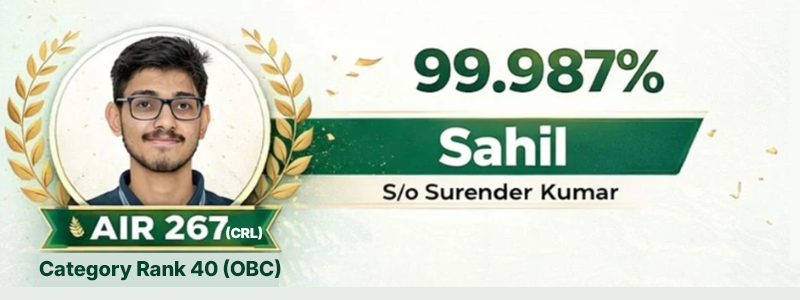
Here are the JEE Main 2026 results of Matrix JEE Academy students, where we have all-India top rankers:
- Matrix Academy, Sikar district top performer – Sahil – 99.987%ile (AIR 267)
- Anshu Meena secured AIR 1180 and ST category rank 8, which is the highest ever recorded result in Sikar district.
- Akshit Meena secured ST Category rank 30, and Khushhal secured ST Category Rank 74, highlighting strong national-level achievement and category excellence.
- 342 students scored 99+ percentile, marking one of the strongest performances in Sikar district
- 18 students achieved 99.90+ percentile, the highest count in the region.
We are positive that our students will outperform and bring the highest IIT Delhi admissions in Sikar this year!
Famous Alumni of IIT Delhi Who Made a Global Impact
The list below highlights the notable alumni of IIT Delhi who have made a memorable global impact, and many have gone ahead to lead global tech giants, shape economic policy and build unicorn startups across diverse industries.
| Name | Class Year | Degree | Notability |
| Sundar Pichai | 1993 | B.Tech. (Metallurgical Engineering) | CEO of Google and Alphabet Inc. |
| Sachin Bansal | 2005 | B.Tech. (Computer Science) | Co-founder of Flipkart |
| Binny Bansal | 2005 | B.Tech. (Computer Science) | Co-founder of Flipkart |
| Raghuram Rajan | 1985 | B.Tech. (Electrical Engineering) | Former Governor of Reserve Bank of India |
| Deepinder Goyal | 2005 | B.Tech. (Mathematics & Computing) | Founder & CEO of Zomato |
| Vijay Shekhar Sharma | 1998 | B.Tech. (Electronics & Communication) | Founder & CEO of Paytm |
| Kunal Bahl | 2007 | B.Tech. (Engineering Physics) | Co-founder of Snapdeal |
| Rohit Bansal | 2007 | B.Tech. (Mathematics & Computing) | Co-founder of Snapdeal |
| Amit Singhal | 1989 | B.Tech. (Computer Science) | Former Head of Search at Google |
| Arvind Kejriwal | 1989 | B.Tech. (Mechanical Engineering) | Chief Minister of Delhi |
| Naveen Tewari | 2000 | B.Tech. (Mechanical Engineering) | Founder & CEO of InMobi |
| Sachin Garg | 1990 | B.Tech. (Electrical Engineering) | Noted technology entrepreneur & investor |
| Manoj Kumar | 1993 | B.Tech. (Mechanical Engineering) | Founder of Naaptol |
| Anurag Dikshit | 1993 | B.Tech. (Computer Science) | Co-founder of PartyGaming |
| Rajiv Bajaj | 1988 | B.Tech. (Mechanical Engineering) | Managing Director of Bajaj Auto |
Conclusion
Getting into the Indian Institute of Technology, Delhi, is not just about clearing an exam but securing a future filled with opportunities. With the right strategy, consistency, and guidance, even the toughest goals become achievable. If IIT Delhi is your dream, start early, stay focused, and aim for a top rank in JEE Advanced to turn that dream into reality. Is IIT Delhi your dream college as well? Start your JEE preparation journey early by joining the right coaching institute that will guide you at every stage. Start your journey today and secure a top rank under 1000 in JEE Advanced to secure your seat in IIT Delhi.
FAQs
The IIT Delhi B.Tech cut off depends on the category and seat availability. For top branches like computer science, candidates typically need a rank within the top 100–120 (general category), while other branches may range between ranks 500 and 4000+, depending on the course and category. Reserved categories have relatively relaxed cut-offs.
For the B.Tech degree, there are 1209 seats in IIT Delhi, of which 79 seats are reserved for the CSE branch, and 96 seats are for the electrical engineering branch. The complete seat matrix of IIT Delhi B.Tech branches will be officially released after JoSAA counselling 2026.
The semester fee at IIT Delhi for a B.Tech is around 1.5 lakhs. The total fees for four years, including the hostel fees, are around 1,040,000. IIT Delhi does provide fee waivers and scholarships.
During the IIT Delhi admission for the B.Tech degree, students will be required to undergo document verification, which will happen at the institute itself. The documents needed during final admission are class 10 & 12 marksheets, JEE Advanced scorecard, the category certificate (if applicable), the birth certificate and a recent passport-sized photograph.
Yes, IITs have reserved 20% supernumerary seats only for female candidates since 2018. These are additional seats and are not included in the already reserved 1209 seats at IIT Delhi.
The minimum rank required for IIT Delhi 2026 depends on the student’s category. For the general category, the closing rank ranges from AIR 126 to 5000, depending on the branch. For the CSE branch, the general category closing rank is AIR 110-120 in 2026.
To get admission into IIT Delhi, students will have to clear the JEE Main exam and be among the top 2.5 lakh qualified candidates. The next step is to clear the JEE Advanced exam and get top ranks to participate in the JoSAA counselling.
To be eligible for admission to IIT Delhi in 2026, candidates must first qualify for JEE Advanced, which requires them to be among the top 2.5 lakh JEE Main candidates. In addition, students must have passed their Class 12 (or equivalent) examination with physics, chemistry, and mathematics, securing at least 75% marks (65% for reserved categories) or ranking within the top 20 percentile of their respective boards. The candidate should be born on or after October 1, 2001, with a 5-year relaxation applicable for reserved categories.