

Zoology Syllabus for NEET UG Exam 2026
The NEET Zoology syllabus is prepared by the National Medical Commission (NMC) and released by the National Testing Agency (NTA). NEET Zoology is a difficult subject that demands conceptual understanding to solve complex and application-based topics/chapters. From human physiology, biotechnology, evolution, to reproductive biology, Zoology is considered the backbone of NEET Biology. So, NEET aspirants must be aware of the complete syllabus of this subject in an organised manner, so they can prepare accordingly.
At Matrix Academy, our NEET Zoology faculty is performing outstandingly under the guidance of Dr Abhinav Badhaniya Sir (10+years of Zoology teaching experience). Abhinav Badhaniya teaches Matrix students with a specialised method combining clarity, logical flow, and exam-focused preparation, all are necessary elements to score high in this area of the Biology subject. We prepared a blog for you after critically analyzing the NEET Zoology syllabus with expert faculties, to give you chapter-wise analysis, weightage insights, and effective study tips to score well in this exam.

NEET Exam Zoology Syllabus Overview
NMC prepares the NEET Zoology syllabus by including chapters and topics from the 11th and 12th class NCERT Biology books. NEET Biology combines two subjects: Botany and Zoology, both are important for effective exam preparation. By effectively analysing the Zoology syllabus, you can strategically plan by prioritising the important topics for the upcoming NEET UG 2026 exam.
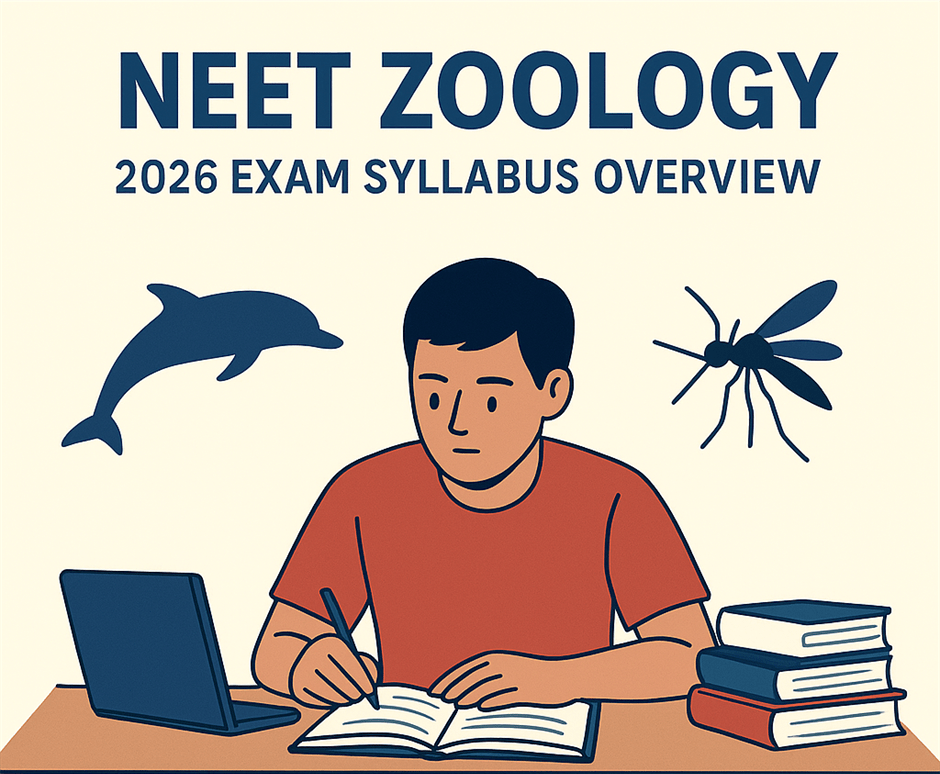
At Matrix Academy, we create a separate syllabus for the Zoology apart from Botany in NEET exam, which will help you in following a realistic study plan to cover this subject without interrupting others.
| Serial Number of NEET Zoology Unit/Chapter | Unit / Chapter of NEET Zoology |
| 1. | Structural Organisation in Animals: It covers animal tissues, animal morphology, and anatomy. A study of earthworm, cockroach, and frog. Basic understanding of organ systems. |
| 2. | Digestion and Absorption: Explanation of the human digestive system, digestive enzymes, digestive glands, disorders (jaundice, diarrhoea, and indigestion), mechanisms of nutrient absorption, and many more. |
| 3. | Breathing and Exchange of Gases: Explanation of the human respiratory system, Gas transmission, breathing mechanism, regulations, and many more. |
| 4. | Body Fluids and Circulation: Blood composition, cardiac cycle, ECG, circulatory disorders, regulation of heart function, and many more. |
| 5. | Excretory Products & Elimination: Formation of nitrogenous wastes, osmoregulation, disorders such as kidney failure and dialysis, and many more. |
| 6. | Locomotion & Movement: Muscle structure, types of movement, and skeletal system functioning, joints, bones, and many more. |
| 7. | Neural Control & Coordination: Sense organs, reflex actions, the spinal cord, the human nervous system, nerve impulse conduction, and many more. |
| 8. | Chemical Coordination & Integration: Hormones and their functions, endocrine system, regulations, disorders (diabetes, hypothyroidism), growth-related abnormalities, and many more. |
| 9. | Animal Kingdom: Animal classification, Body plans, symmetry, germ layers, distinguishing features of each phylum, and many more. |
| 10. | Animal Morphology: Anatomy and external morphology of animals like the earthworm, cockroach, and frog. Overview of organ systems. |
| 11. | Biomolecules: Structure, types, and functions of Biomolecules. Carbohydrates, proteins, lipids, nucleic acids. Basic enzymology. |
| 12. | Human Reproduction: Female and male reproductive systems, menstrual cycle, gametogenesis, fertilisation, pregnancy, embryonic development, parturition, and many more. |
| 13. | Reproductive Health: Family planning, STDs, infertility, assisted reproductive technologies (IVF, ICSI), strategies for healthy reproductive practices, and many more. |
| 14. | Evolution: Life origin, evolution theory, speciation, evolution evidence, Hardy-Weinberg principle, human evolution, and many more. |
| 15. | Human Health & Diseases: Explanation of pathogens, bacterial, viral, protozoan diseases, immunity, vaccines, allergies, cancer, AIDS, drug/alcohol abuse, and many more. |
| 16. | Microbes in Human Welfare: Beneficial microorganisms in food processing, sewage treatment, bio-control, biofertilisers, antibiotics, and their role in human welfare. |
| 17. | Biotechnology: Principles & Processes: Basic overview of biotechnology tools, processes involved in genetic engineering, and many more. |
| 18. | Biotechnology & Applications: Applications of biotechnology in agriculture (Bt crops), medicine (gene therapy, recombinant vaccines), industry, diagnostics, and ethical issues. |
NEET Zoology Chapter-wise Syllabus, Focus Topics & Weightage
NEET Zoology is a subject that can only be prepared by understanding the logic and concepts in practical and theoretical topics. For this, the Zoology faculty at Matrix Academy conducted a pattern-backed micro-analysis of the last 10-15 years’ exam papers to identify focus topics. The analysis below covers the critical topics and their approximate exam weightage for the upcoming NEET UG 2026 exam.

| Chapter | Key Focus Topics (Matrix Academy Recommended) | Approx. NEET Weightage |
| Structural Organisation in Animals | Frog digestion, animal tissues, and histology diagrams | 4–5% |
| Digestion & Absorption | Enzymes, liver functions, carbohydrate digestion | 3-4% |
| Breathing & Exchange of Gases | Oxygen dissociation curve, transport of gases | 3–4% |
| Body Fluids & Circulation | ECG interpretation, cardiac cycle steps | 4-5% |
| Excretory Products & Elimination | Counter-current mechanism, hormonal control of the kidneys | 2–3% |
| Locomotion & Movement | Sliding filament theory, types of joints | 3% |
| Neural Control & Coordination | Synaptic transmission, CNS parts | 4–5% |
| Chemical Coordination & Integration | Endocrine disorders, hormone mechanisms | 4-5% |
| Animal Kingdom | Basis of classification, examples from each phylum | 6–7% |
| Animal Morphology | Cockroach anatomy diagrams | 2% |
| Biomolecules | Enzyme inhibition, protein structure | 6-10% |
| Human Reproduction | Hormonal regulation, menstrual cycle | 8–10% |
| Reproductive Health | Contraceptive methods | 2% |
| Evolution | Hardy–Weinberg law, evidence | 8-10% |
| Human Health & Diseases | Immunity types, vaccines | 8–9% |
| Microbes in Human Welfare | Antibiotics, biofertilisers | 2–3% |
| Biotechnology: Principles & Processes | Tools of rDNA tech, PCR steps | 5% |
| Biotechnology & Applications | GMO, gene therapy | 4% |
High-Weightage NEET Zoology Chapters Identified by Matrix Academy Faculty
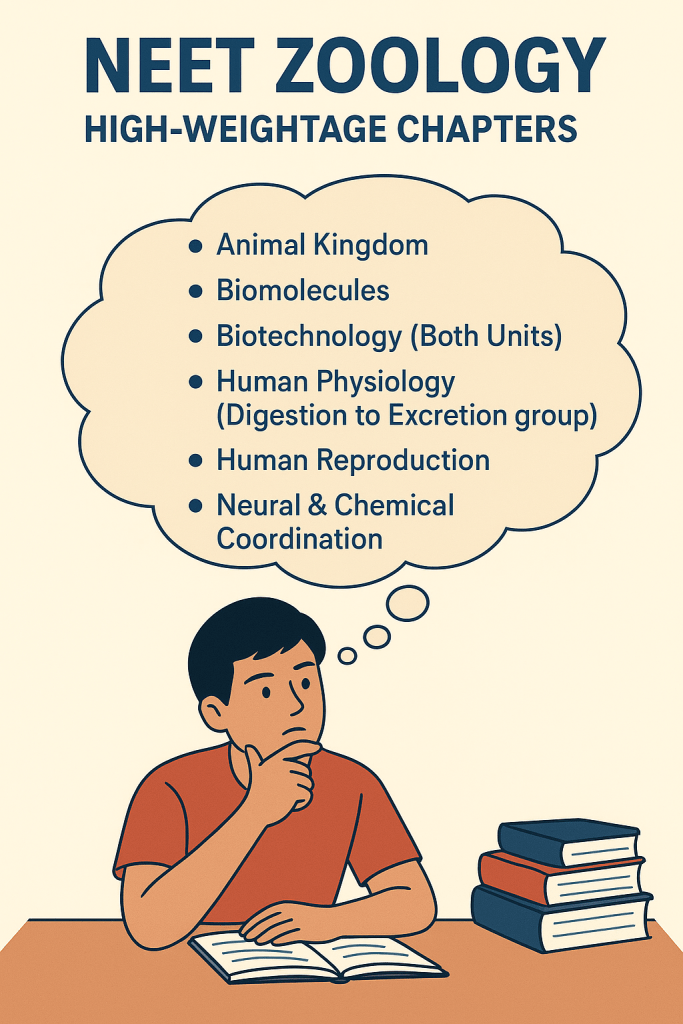
NEET Division at Matrix Academy prioritises Zoology chapters by analysing previous year papers using a 3-tier research process. This process consistently records the topics and chapters that have been frequently asked in the final NEET exam and provides their solutions in an easy, organised manner. These chapters not only have the highest number of direct questions, but also comprise concept-based links with other topics. The list below was prepared by our NEET experts to prioritise the highest-weightage Zoology chapters and their key topics to focus on-
| Name of the Chapter | Why is this a High Weightage Chapter? | Key Topics to Prepare (Matrix Academy Recommended) |
| Animal Kingdom | The chapter covers a wide range of animal classification topics, with approximately 6-7 questions asked every year, examples of phyla, and diagram-based questions suitable for 11th and 12th-grade Biology students. | Basis of classification, Body Plans, Examples of various Phyla, Chordata & Vertebrates, Animal tissues, Frog morphology & Anatomy, |
| Biomolecules | The chapter is useful in providing a basic and advanced understanding of living organisms by combining important concepts such as Human Physiology, Cell Biology, and Molecular Biology. Conceptual and numerical enzyme questions are frequently repeated in the final exam. | Protein Structure, Enzyme, Lipids, Kinetics, Carbohydrates |
| Biotechnology (Both Units) | It covers the Modern Biology focus, Recombinant DNA Technology, PCR, Cloning, and Genetic Engineering. Approximately covers 9–12 marks | DNA Tools, PCR, Cloning Vectors, Bt Cotton, Gene Therapy, Principles & Processes.Some Interconnected Topics: Evolution, Molecular Basics of Inheritance, Cell Cycle & Cell Division. |
| Human Physiology (Digestion to Excretion group) | Human Physiology combines 12–15 questions every year with relevance to medical, Application-based questions, and focuses on Homeostasis. | Enzymes, Alimentary Canal & Enzymes, Cardiac Physiology, Locomotion, Hb Curve, Neuron & Synapse |
| Human Reproduction | High number of Diagrams and Hormone-based questions, Physiological processes, and Core Medical Relevance. | Gametogenesis, Menstrual Cycle, Male/female Anatomy, Hormonal Control, Pregnancy Stages, Fertilisation, and Embryonic Development |
| Neural & Chemical Coordination | Advanced-level Conceptual Questions (4-5 every year) related to Fundamental Human Physiology. | Brain Parts, Reflex Arc, Endocrine Pathways, Nerve Impulse Transmission, and Human Nervous System. |
According to Dr Abhinav Badhaniya, you should effectively focus on the Human Physiology block, which he believes is a good area for scoring. In the NEET Zoology section, the Human Physiology section holds the highest weightage, which approximately comprises 35-45% of the entire Zoology section. This section is based on interconnected physiology topics, where continuous study practice are important to score well.
Apart from this, Biotechnology and Animal Kingdom are also important chapters to prepare for the NEET UG exam 2026 due to predictable patterns, smart memorisation in examples, and high-level dependency on NCERT topics. You should also focus on revising Biomolecules multiple times because questions often revolve around enzyme action and structural categories. By regularly practising these chapters, you can effectively score 160+ marks out of 180 in the NEET Zoology section.
Preparation & Study Tips Suggested by Matrix Academy for NEET Zoology 2026
NEET Zoology preparation and study approach at Matrix Academy is primarily based on covering the NCERT, practising question papers, conceptual clarity, and participating in structured test strategies. Some practical preparation & study tips to strengthen your NEET Zoology exam preparation are as follows-
1. Focus on Building Conceptual Foundation Through NCERT Line-by-Line Mastery and Consistent Practice:
Under the guidance of Dr Abhinav Badhaniya at Matrix Academy, students are performing very well with high-quality NEET results, where our students are scoring 650+, 700+, and even 705+ marks continuously out of 720 marks. Matrix teaches Zoology to its students by covering the NCERT line by line, highlighting definitions, examples, labelled diagrams, flowcharts, and in-text tables. Every student maintains a separate NCERT error book to record mistakes, tricky lines, and highly repetitive topics. The key suggestions offered by Matrix Academy for NEET Zoology preparation are as follows-
- Short revision notes.
- At least 30-40 minutes daily revision of Zoology topics.
- Regular practice of 100-150 MCQs daily.
- Attempting Matrix-designed mock tests and their thorough analysis to identify mistakes and weak areas.
- Practising diagrams and examples to gain conceptual clarity.
Matrix NEET Zoology Book 2026 is a premium 2-book set that combines highly researched 550+ MCQs and 250+ PYQs, which is designed to make you an expert in this subject.
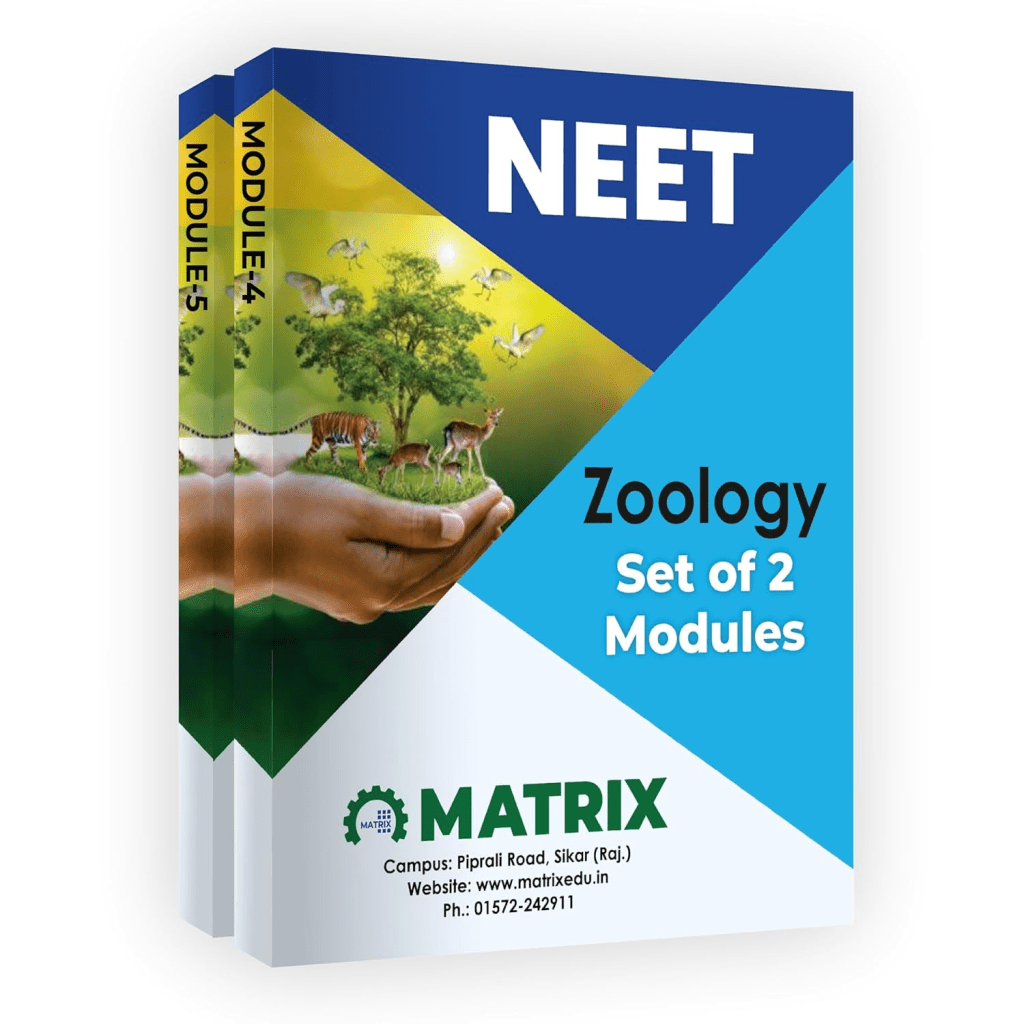
Matrix Academy creates a balance between NCERT and reference books to score well in this subject by developing conceptual clarity from basic to advanced levels. The strategy aims to reduce confusion, strengthen retention, and boost accuracy for factual questions.
2. Effective Preparation Strategy for Each Chapter in NEET Zoology
One of the most effective strategic approaches implemented by Matrix Academy is using an individual preparation strategy for Zoology chapters, as per their nature. This approach ensures conceptual clarity and prioritisation of high-weightage chapters in an organised manner.

- For example, Human Physiology is a highly logical chapter, so Matrix especially teaches with mechanism-based learning instead of rote memorisation. Students regularly practice physiological processes, like gas exchange, circulation, digestion, excretion and neural signalling with diagrams and flowcharts. This ideal approach offers a clear and easy explanation of the complex topics.
- The Matrix-integrated topic correlation approach is designed to create an easy link between common topics. For example, hormones with digestion, respiration with circulation, and neural regulation with muscular movement. The successful implementation of this approach helps in building a holistic understanding to solve application-based multi-concept NEET questions.
- For Animal Kingdom, the preparation should be based on memorisation. At Matrix, we recommend that our students prepare this chapter with pattern-recognition tables, comparison-oriented charts, and mnemonic blocks.
- For Biomolecules, students prepare with the classification of important topics like proteins, enzymes, and carbohydrate types through logical tags instead of blindly learning them. During the preparation of the Reproduction chapter, students practice this by mapping (curriculum-based) hormone cycles, gamete formation, and gestation stages in timeline charts.
- Matrix also promotes a system to revise a chapter after 1 day, 1 week, and 1 month for long-term memory retention.
3. Practising NEET Zoology Targeted Questions & Attempting Regular NEET-Pattern Tests:
One effective way to practice NEET Zoology is consistently solving high-quality and concept-oriented questions to reduce the number of failed practice attempts. You can also practice with the Matrix Academy-designed NEET-type questions book by covering application, assertion-reasoning, and NCERT-line testing. NEET Zoology faculty Abhinav Sir recommends that their students always participate in topic-wise practice after the completion of each lecture and discuss the difficult topics in doubt-solving classes. This approach is also useful during weekly and monthly chapter tests. Zoology students learn to analyse their errors through Matrix’s detailed test feedback system, with the identification of conceptual gaps and the need for revision.

To become a master in NEET Biology, you can explore our detailed blog on How to Prepare Biology for NEET UG 2026 to become an expert in the Botany and Zoology subjects for the upcoming NEET UG 2026 exam.
Conclusion
If prepared and studied well, NEET Zoology is one of the most scoring and conceptually strong parts of the NEET Biology. To become a master in this subject for the NEET UG 2026 exam, you should study with structured planning, concept-based learning, and maintain consistency in practice. Some of the important chapters for the NEET Zoology 2026 exam are Animal Kingdom, Biomolecules, both units of Biotechnology, Human Physiology, Human Reproduction, and Neural & Chemical Coordination. According to Matrix Academy, NEET Zoology preparation may become more effective with chapter-wise analysis, identification of priority areas, and preparation tips mentioned above.
Also Read:
- NMC Notification: NEET Exam 2026 Updated Syllabus
- NEET Botany Syllabus 2026: Complete Chapter-Wise Topics & Weightage for NEET UG
- High-Weightage Chapters for NEET 2026: Matrix Faculty Analysis
FAQs
Zoology at the NEET level is based on the 11th and 12th class NCERT books. The syllabus comprises chapters like Animal Kingdom, Human Physiology, Biomolecules, Biotechnology, Reproduction, Evolution, and others. This syllabus, updates, and criteria are developed by NMC and implemented by NTA.
At Matrix, we recommend that our students prepare and cover all the chapters equally to score well on the final exam. But some of the high-weightage chapters frequently asked in previous year exam papers are Biomolecules, Biotechnology units, Human Physiology, Human Reproduction, Animal kingdom, and Neural & Chemical Coordination.
In recent years, the weightage of Human Physiology has been consistently high, which nearly covers 35–45% of the Zoology section. The topics in this chapter are interconnected, highly application-based, and frequently asked by making continuity-based study essential for scoring high marks.
At Matrix Academy, Abhinav Badhaniya Sir recommends that our students focus on enzymes, cardiac cycle, synaptic transmission, endocrine pathways, phylum examples, biomolecules classification, rDNA tools, PCR, reproductive hormones, and evolution principles. All these topics are frequently asked in the NEET exam paper every year.
At Matrix Academy, we create a system for the concept-based preparation of the NEET Zoology. Students should practice Zoology by covering the NCERT line-by-line, recording mistakes and complex topics in an error book, and daily practising the subject for 30-40 minutes. To strengthen your final Zoology preparation, you can practice 100–150 MCQs, make diagrams, and attempt Matrix mock tests to identify weak areas.
The best way to learn Human Physiology is to practice with mechanism-based diagrams and flowcharts, while Animal Kingdom preparation should be based on practising with tables, comparisons, and examples.
You should study Zoology by attempting topic-wise chapters and NEET pattern tests to cover all the conceptual gaps during practice. You can improve your performance by studying NCERT to improve accuracy and build exam confidence through consistent practice and detailed feedback analysis.








![Updated NEET Exam 2026 Syllabus [Released by NTA!!] Download PDF](https://www.mycareer.matrixedu.in/wp-content/uploads/2025/12/Updated-NEET-Exam-2026-Syllabus-Released-by-NTA-Download-PDF-256x256.webp)