


NEET Botany Syllabus 2026: Complete Chapter-Wise Topics & Weightage for NEET UG
The NEET UG exam 2026 can be effectively cracked by making an individual preparation strategy to cover the entire Botany syllabus. The Botany syllabus preparation should cover key aspects such as clearing concepts, a smart strategic approach, and a disciplined study plan. This approach is also useful for the NEET Botany (Biology) subject, which can boost your overall rank.
An effective level of preparation cannot be implemented without the in-depth evaluation of the NEET Botany syllabus and systematic preparation. At Matrix Academy, Botany is taught to our students with conceptual clarity, visual understanding, and an exam-oriented strategic approach. So, this blog will briefly describe the NEET Botany syllabus, key topics, high-weightage chapters, and study tips for the upcoming 2026 exam.

NEET Botany Syllabus Overview for 2026 Exam
The NEET Botany (Biology) covers structural, functional, molecular, and applied functions of plant science. Botany syllabus is accountable for 180 marks and 45 questions, similar to NEET Zoology. The NEET Botany syllabus is a plant science subject that includes a wide range of topics from the basics of life forms to advanced genetic mechanisms, environmental interactions, and biotechnology. This strengthens the need to understand the subject’s syllabus to identify its scope, depth, and pattern.
Matrix Academy Botany faculty ensures that NEET exam aspirants always get support from their structured approach towards teaching. The subject preparation starts from foundational concepts and gradually shifts towards high-level problem-solving by offering complete command over the NCERT. The following list offers a brief overview of the primary NEET Botany syllabus chapters and their coverage, so you can effectively prepare for the upcoming NEET UG 2026 exam.
| NEET Botany Syllabus/Chapter | What Each Chapter Covers |
| The Living World | Characteristics and definition of life, Taxonomy, Plant Classifications, Nomenclature, and Biodiversity topics. |
| Biological Classification | System of Five Kingdoms and their featuresFungi kingdomMonera kingdomPlantae kingdomAnimalia kingdomProtista kingdomViruses, Viroids, Lichens, Prions, and Classification Systems |
| Plant Kingdom | Algae, Bryophytes, Pteridophytes, Gymnosperms, and the fertilisation of Angiosperms |
| Morphology of Flowering Plants | Root (modifications & type), Stem, Leaf (venation, phyllotaxy, modifications), inflorescence, Fruit, Seed (types & structure) |
| Anatomy of Flowering Plants | Plant tissues and their systemsSecondary growthAnatomy of the leaf, stem, and rootStomata and Trichomes |
| Cell – The Unit of Life | Cell structure and Cell theoryPlastids, Cytoskeleton, Cilia, FlagellaOrganelles and biomolecules |
| Cell Cycle and Cell Division | A sequence of cell growth (Prophase, Metaphase, Anaphase, and Telophase) & divisionMitosis, Meiosis, and Cell Cycle Regulation |
| Photosynthesis in Higher Plants | Light and dark Reactions, Pigments, C3/C4/CAM pathwaysATP & NADPH useFactors creating an impact on Photosynthesis |
| Respiration in Plants | Glycolysis, ETC, Aerobic Respiration, Fermentation, and Pathways amphibolic nature of pathways, Fate of Pyruvate, and ATP yield |
| Plant Growth and Development | Growth Hormones and their affecting factors, Growth regulators, Differentiation, and Photoperiodism |
| Mineral Nutrition | Need of Plant Minerals, Essential elements, Deficiency symptoms, Nitrogen metabolism, and Biological Nitrogen Fixation (BNF) |
| Reproduction in Organisms | Asexual and Sexual reproduction, Flowering plants, Pre-fertilisation, Fertilisation & Post-fertilisation events |
| Sexual Reproduction in Flowering Plants | Pollination, Fertilisation, Seed & Fruit development, and Pollination types |
| Organisms and Populations | Population Attributes, Interactions (Mutualism, Competition, Predation, Parasitism, Commensalism), Ecological Concepts |
| Ecosystem | Food Chains, Energy Flow, Productivity, Decomposition, Nutrient Cycling, Succession, and Ecological Pyramids |
| Biodiversity and Conservation | Biodiversity types and importance, conservation methods and strategies, Loss of Biodiversity |
| Environmental Issues | Pollution, Waste management (solid and e-waste), Ozone depletion, Agrochemicals & Organic Farming, Eutrophication |
| Principles of Inheritance & Variation | Mendelian Genetics, Deviations, Chromosomal Theory, Linkage & Recombination, Sex Determination, Mutations, and Genetic Disorders |
| Molecular Basis of Inheritance | DNA, RNA, Replication, Transcription, Translation |
| Biotechnology: Principles, Processes & Applications | Genetic engineering, PCR, rDNA technology |
NEET Botany Chapter-wise Syllabus
NEET Botany preparation is a subject that can be prepared by having clarity in fundamentals instead of just simple memorisation. At Matrix Academy, our Botany faculty, Arihant Jain Sir and Abhishek Singh Sir, conduct in-depth analysis of past 10-year papers to identify the “core scoring areas and high-weightage chapters that significantly influence final scores. The Molecular Basis of Inheritance unit leads with nearly 14-15% weightage, considered as one of the most crucial segments. Students must primarily focus on effectively preparing chapters like Genetics, Molecular Biology, and Cell Biology while also mastering factual units like Plant Kingdom and Reproduction.

NEET Botany Syllabus Weightage and Key Focus Areas
The following table comprises the syllabus of NEET Botany, its weightage and key areas to focus on-
| Chapter | Key Topics Suggested by Matrix Faculty | Approximate Weightage (%) |
| The Living World | Concept of Living: Taxonomy hierarchy, Binomial nomenclature, Concept of Species | 1% |
| Biological Classification | Kingdom Monera, Protista, Fungi; Viruses & Viroids | 3-4% |
| Plant Kingdom | Algae & Bryophytes differences, Gymnosperm features, Angiosperm trends, and life cycles. | 6-7% |
| Morphology of Flowering Plants | Inflorescence, Floral formulas, and modifications | 6% |
| Anatomy of Flowering Plants | Xylem & phloem details and Secondary growth | 7% |
| Cell – The Unit of Life | Membrane models, organelles, prokaryotic vs eukaryotic cells | 4-5% |
| Cell Cycle & Division | Mitosis vs meiosis, phases, and regulation | 8-9% |
| Photosynthesis | Light reactions, C3/C4/CAM pathways | 3% |
| Respiration | Glycolysis, ETS, RQ | 2% |
| Plant Growth & Development | Plant hormones, vernalization, photoperiodism | 5% |
| Mineral Nutrition | Nitrogen cycle, deficiency symptoms | 2% |
| Reproduction in Organisms | Asexual reproduction types | 1% |
| Sexual Reproduction | Double fertilisation, pollen-pistil interaction | 5% |
| Organisms & Populations | Population interactions (predation, parasitism) | 2% |
| Ecosystem | Energy flow, pyramids | 2% |
| Biodiversity | Biodiversity types, hotspots | 1% |
| Environmental Issues | Pollution, ozone depletion | 1% |
| Principles of Inheritance | Mendelian disorders, linkage & mapping | 5% |
| Molecular Basis of Inheritance | Replication, transcription, translation, operon concept | 14-15% |
| Biotechnology | PCR, restriction enzymes, cloning vectors | 5% |
Matrix Academy teaching methods always encourage and promote conceptual understanding to learn Botany complex topics: operons, double fertilisation, plant hormones, Mendelian genetics, and DNA replication.
High-Weightage NEET Botany Syllabus Chapters
NEET aspirants must study with a dual practice approach for the chapters that frequently deliver the highest number of questions. Matrix Academy implements this dual-practice approach with the combination of two methods in teaching: thorough conceptual mastery and extensive question practice of the previous year’s question papers.
At Matrix Academy, Arihant Jain Sir conducted extensive research on the last 10-15 years of Botany section exam papers, which clearly identifies the Molecular Basis of Inheritance, Principles of Inheritance, Cell Cycle, Plant Growth, and Sexual Reproduction in Flowering Plants as the most scoring chapters. All of these chapters combine more than 40% of the Botany section weightage. A good and in-depth preparation of these chapters should be based on in-depth conceptual clarity with a focus on diagrams, exceptions, and NCERT topics. The key high-weightage chapters of NEET Botany are as follows-
| Name of the Chapter | Why is this a High-Weightage Chapter? | Key Topics to Prepare (Matrix Recommended) |
| Molecular Basis of Inheritance | The chapter offers conceptual depth of (DNA, replication, transcription, translation, gene regulation, and mutations. | DNA replication, operon model, genetic code, transcription, translation, mutations |
| Principles of Inheritance & Variation | Effectively covers genetics, which is essential for understanding heredity and evolution. The majority of numerical questions are asked from this section. | Mendelian laws, Deviations, Pedigree analysis, Linkage and Recombination, and Blood Groups. |
| Cell Cycle & Cell Division | Direct coverage of important topics from NCERT with predictable question patterns. Fundamental life processes.2-4 questions annually, based on concepts, checkpoints, and mechanisms. | Mitosis vs meiosis, regulation & checkpoints, abnormal cell division. |
| Sexual Reproduction in Flowering Plants | Direct NCERT questions (approximately 3-4 every year), direct link with other topics like evolution and principles of inheritance. | The chapter combines important chapters like fertilisation, pollination, seed and fruit development, embryo sac, and many more. |
| Plant Growth & Development | Hormone-based application questions (2-3 questions approximately). This chapter is an effective source that creates an interlink between morphology and physiology topics. | Hormones, plant growth regulators, seed dormancy and germination, vernalization, and many more. |
| Plant Kingdom | High-scoring chapter that creates a basic foundational level of plant life with approximately 3-4 questions. The chapter provides an overview of diversity and an introduction to broad groups like gymnosperms, angiosperms, and algae. | Algae, basics of bryophytes, gymnosperms, pteridophytes, angiosperms, and many more. |
| Cell – The Unit of Life | Diagram and definition-based questions (4-6 questions every year). A direct relation with other high-weightage chapters like respiration, plant tissue system, and molecular inheritance. | Organelles, cytoskeleton, microbodies, membrane models and systems, cell envelope, and many more. |
| Anatomy of Flowering Plants | The anatomy of flowering points is a memory-based chapter with 2-3 questions every year. The chapter explains fundamental concepts and functions of basic tissue types. | Ø Tissues (meristematic, permanent, secondary), Tissue systems, monocot & dicot parts anatomy, vascular bundles. Ø Apart from the topics, the chapter also consists of various important diagrams like the stomatal apparatus, dicot stem secondary growth, and the stem. |
| Biotechnology – Principles & Applications | Biotechnology is divided into 2 units and covers approximately 8-10 questions. Biotechnology: principles and processes- 5-6 questions every year. The Biotechnology and Its Applications – 3-4 questions. Both units have topics related to the modern world and application-based questions. | Biotechnology Principles: Recombinant DNA Technology, genetic engineering tools, PCR, Bioprocessing & Downstream Processing, and others. Biotechnology Applications: Medicine, agriculture, Transgenic Animals and others. |
Arihant Sir uses his expertise while making the above table and identifies that the above-mentioned chapters are not only considered due to their high weightage, but they also link multiple topics of Biology.
- For example, the Molecular Basis of Inheritance is a high-weightage chapter, but it is also interrelated with Biotechnology and Genetics. At Matrix Academy, NEET students are trained in classes to actively solve and attend processes like replication and translation through diagrams, flowcharts, and repeated objective practice.
- While preparing the Plant Growth & Development and Sexual Reproduction in Flowering Plants chapter, NEET students must practice 100-150 application-based MCQs from basic to advanced level, which will increase their mastery in these chapters by 2-3 times. NEET Botany faculty teaches these chapters with practical visualisation and learning from animations and visual diagrams, so they can remember topics like functions, pollination mechanisms, and fertilisation events.
- Biotechnology is a combination of 2 units with 8-10 questions every year in the final exam. These chapters can help you in scoring good marks if your basics and concepts are clear. For these units, Matrix Academy organises extra remedial and doubt-solving classes by ensuring that students become experts in topics like enzyme functions, vector properties, and PCR steps.
NEET Botany Syllabus Preparation & Study Tips
A complete NEET Botany preparation demands an extensive coverage of the Botany syllabus. At Matrix Academy, our teaching methodology effectively streamlines this process for medical students. So, you can consider the following preparation & study tips to cover the entire NEET Botany Syllabus in an organised manner-
1. Creating a Balance Between the NCERT and Matrix Course Book
Approximately 85-90% questions in the NEET Botany syllabus are from the NCERT (11th & 12th) books. This clearly shows the value of NCERT books and revision to learn with a conceptual understanding of each topic. For this, Matrix Academy faculty, Arihant Jain Sir, suggests that their students read the NCERT with a triple-layer reading approach as follows-
- Reading the NCERT book first time to create a basic level understanding.
- Reading second time for the long-term retention of important topics.
- Reading third time for active recall and final revision without ignoring important topics, tables, diagrams and key terms.
For the remaining 10-15% and higher-level problem-solving questions, you should take assistance from a good and well-organised supplementary Botany book. For this, you can become a master with the Matrix-designed NEET Botany 5 book set that combines 900+ PYQs and 1900+ MCQs. The book has approximately 4350+ questions and 4 power exercises that offer brainstorming challenges for complete preparation of the Botany subject.
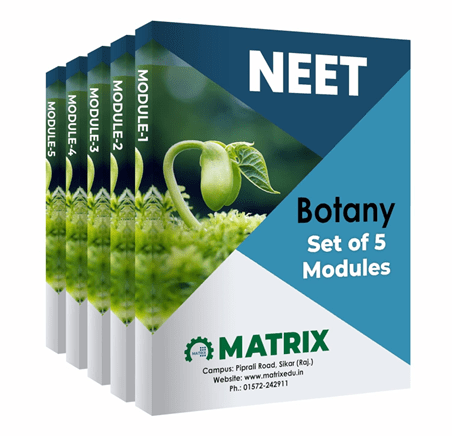
By taking support from the Matrix NEET Boatny book set, you can develop conceptual clarity, speed, and accuracy for the upcoming NEET UG 2026 exam.
2. Practising with Visual Memory through Diagrams & Flowcharts
Approximately 10-12% topics in NEET Biology (Botany + Zoology) are diagram-based, so it is important to practice with the visualisation of key Botany topics like hormone actions, replication mechanism, and photosynthesis pathways.
Matrix MATLAB is a separate learning video-based platform that includes visual diagrams in notes and video-based solutions of the Botany topics for the concept clarification of complex topics. Matrix NEET students learn Botany with flowcharts, summary diagrams, and memory maps, where they are also encouraged to recreate these formulas multiple times to ensure quick recall during the final NEET exam. You can also learn how to make effective Biology notes for the Botany subject to make important chapter notes with the help of diagrams and flowcharts.
3. Solving High-Level Questions & Repeated Modules
Matrix Academy links NEET Botany chapters with concept→ note→ application method, to enforce conceptual clarity with regular practice. For an effective NEET Botany preparation, there should be no scope for doubts. For this, Arihant Jain Sir conducts practice sessions to solve the last 15 years’ papers and topic-wise practice sheets. Students also practice with weekly/monthly tests, NCERT-based objective sets, and module-based exercises under the guidance of experienced faculty. This practical approach creates a system where students get familiar with the question and exam pattern without scope for any doubt in the final exam.
4. Systematic Revision with Matrix’s 3-Cycle Revision Method
Revision is an important factor for NEET Botany that ensures long-term memory retention of the key topics. For this, Matrix Academy divides the revision cycle into 3 important phases as follows-
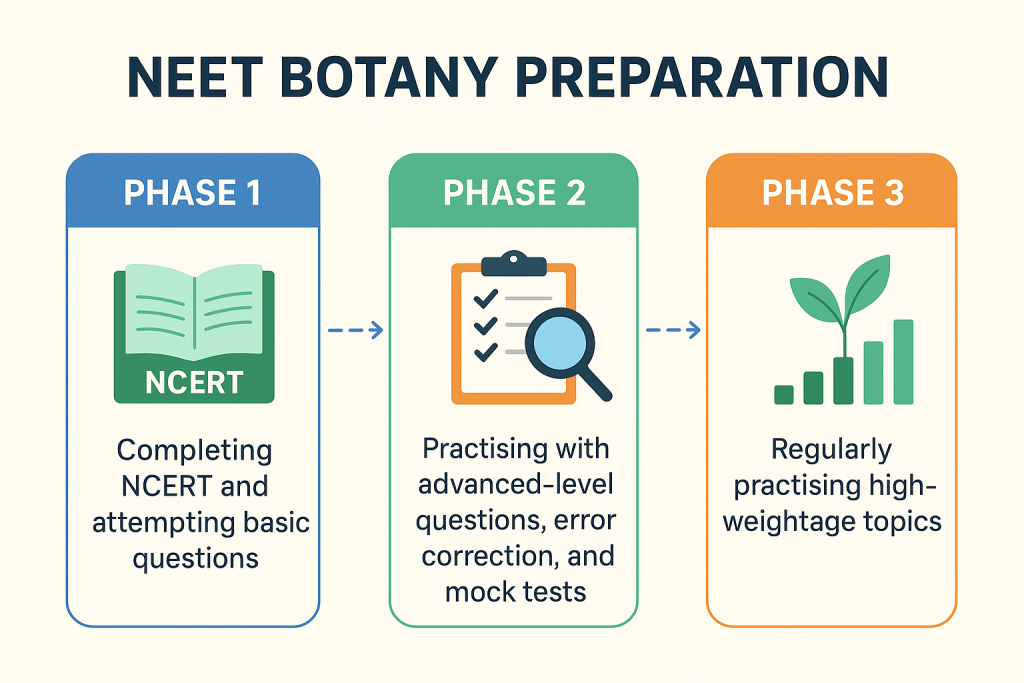
- Phase 1: Completing NCERT and attempting basic questions.
- Phase 2: In this phase, the focus should be on practising with advanced-level questions, error correction, and mock tests.
- Phase 3: The final phase of revision should focus on regularly practising high-weightage topics to score well in the final exam.
For an organised and effective NEET Botany preparation, you can read our blog: How to prepare Biology for NEET UG 2026, which offers you informative insights regarding Zoology and Botany preparation to score well in the Biology section.
Conclusion
Botany is an important section of NEET Biology, where you can score good marks in this Biology area by using a strategic approach and discipline. You can effectively cover the Botany syllabus by creating conceptual clarity regarding the chapters and topics. Some of the high-weightage chapters are Molecular Basis of Inheritance, Biotechnology (both units), Principles of Inheritance & Variation, Sexual Reproduction, Cell Cycle & Cell Division, and Plant-related chapters. A consistency in revision, conceptual clarity, and regular memorisation of complex topics will create a strong foundation during preparation for this subject.
FAQs
The NEET Botany syllabus is approximately divided into 19-20 chapters, such as plant diversity, cell biology, physiology, molecular basis of inheritance, reproduction, genetics, ecology, and biotechnology. All of these chapters are from the 11th and 12th class NCERT with a clear focus on diagrams, conceptual clarity, and application-based understanding.
Matrix Academy allocates separate preparation time for each chapter to score high marks in the final exam. But some important and high-weightage chapters of NEET Botany are Molecular Basis of Inheritance, Principles of Inheritance, Cell Cycle, Sexual Reproduction in Flowering Plants, Plant Growth & Development, and Biotechnology. These chapters approximately cover 40% of the Botany syllabus for NEET UG 2026.
Your NEET Botany preparation can be improved by practising the NCERT regularly, which approximately covers 85-90% syllabus. After this, you can prepare with a specific course book designed by Matrix Academy. You should complete the whole syllabus by creating a basic understanding, memorising keywords, and actively revising the key topics.
You can practice NEET Botany by practising with flowcharts, memory maps, and visual representations of diagrams to understand complex topics. This approach is very useful while practising complex topics like replication and photosynthesis.
You can strengthen your problem-solving skills by regularly solving MCQs, PYQs, module exercises, topic-based revision, and weekly/monthly tests to improve overall accuracy and speed.
Matrix Academy NEET division designed a specific revision plan, which is divided into 3 main phases as follows-
Phase 1: Covering the NEET Botany syllabus with NCERT-based basic questions.
Phase 2: Regularly practising advanced-level questions and mock tests.
Phase 3: A regular revision of high-weightage chapters to maximise performance before the upcoming 2026 exam.
You can download NEET UG 2026 Botany syllabus PDF from here.