

JEE Main 2026 Session 2: Exam Date, Admit Card, City Slip & Latest Updates
JEE Main 2026 Session 2: Exam Date, Admit Card, City Slip & Latest Updates
The JEE Main 2026 Session 2 exam is scheduled from April 2 to April 8, 2026, with two shifts daily (9 AM – 12 PM and 3 PM – 6 PM). The National Testing Agency (NTA) has released the city intimation slip, and the admit card has been released for all exam dates. The JEE Main 2026 Session 1 exam was conducted from January 21, 2026, to January 29, 2026. JEE Main is a national-level entrance exam conducted by NTA for admission to engineering, architecture, and planning programs across India. JEE Main is also an eligibility test to give the JEE Advanced exam, which is a gateway to IITs.
The JEE Main 2026 April session is approaching, and students are advised to stay aware of the latest exam updates. This article provides all the latest updates on JEE Main 2026 Session 2, including exam dates, admit card, city slip, eligibility, syllabus, expected cut-offs, Session 1 paper analysis, and last-minute preparation strategy.
Check out the JEE Main 2026 Session 2 all-shift analysis below:
- JEE Main 2026 Session 2 Paper Analysis (All Shifts) (Live)
- JEE Main 2026 Session 2 Paper Analysis (April 2 Shift 1) – Live
- JEE Main 2026 Session 2 Paper Analysis (April 2 Shift 2) – Live
- JEE Main 2026 Session 2 Paper Analysis (April 4 Shift 1) – Live
- JEE Main 2026 Session 2 Paper Analysis (April 4 Shift 2) – Live
- JEE Main 2026 Session 2 Paper Analysis (April 5 Shift 1) – Live
- JEE Main 2026 Session 2 Paper Analysis (April 5 Shift 2) – Live
- JEE Main 2026 Session 2 Paper Analysis (April 6 Shift 1) – Live
- JEE Main 2026 Session 2 Paper Analysis (April 6 Shift 2) – Live
- JEE Main 2026 Session 2 Paper Analysis (April 7 Shift 2) – Live
- JEE Main 2026 Session 2 Paper Analysis (April 8 Shift 2) – Live

JEE Main 2026 Session 2 Live Updates
- Latest Update April 1, 2026: The admit cards for JEE Main 2026 Session 2 exam dates 5,6,7 and 8 are available now.
- Exam Dates: JEE Main 2026 Session 2 exam dates are April 02, 03, 04, 06, 07, 08, 2026. The JEE Main 2026 Session 1 exam was successfully conducted on these exam dates: January 21, 22, 23, 24, 28 and 29.
- Admit Card: The admit card of JEE Main 2026 Session 2 is released on 29th March, 2026, for only exam dates 02 and 04 April, 2026. NTA released the JEE Main Session 1 admit card for the exam dates January 21, 22, 23 and 24 on 17th January, 2026.
- City Intimation Slip: The JEE Main 2026 April Session city intimation slip was released on March 21, 2026. On January 8, 2026, NTA released the notification that the JEE Main 2026 Session 1 city intimation slip has been released.
- Application form correction window: The correction window for Session 2 was open from 27th February 2026 to 28th February, 2026. NTA has announced that the application form correction window is open from December 1 to December 2, 2025.
- Result Date: The JEE Main 2026 Session 1 results were released on 16th February, 2026. The JEE Main 2026 April Session result is expected to be released in the last week of April 2026.
- JEE Main registration for Session 2: NTA started the registration for JEE Main 2026 Session 2 on 01 February, 2026. The last date to apply was 13th March, 2026.
- JEE Main 2026 Session 1 final answer key: The final answer key for the January session was released on 16th February, 2026. On the 4th of February, 2026, NTA released an official notification on the Display of Provisional Answer Keys and the recorded response sheet for the answer key.
- JEE Main Answer Key Challenge: Students could challenge the answer key and raise objections until the 6th of February (11:50 pm).
- JEE Main 2026 Session 1 registration: On 1st of February, 2026, NTA officially released a notification inviting students to register for JEE Main Session 2 in April. The last date to register for the January session was 31st October, 2026.
JEE Main 2026 Session 2 Exam Dates
The exam dates have been revised by NTA, and the final dates are out now. The JEE Main 2026 Session 2 exam is scheduled from April 02, 2026, to April 08, 2026. As per the latest notification and city intimation slip, the revised JEE Main 2026 Session 2 exam dates and days are April 2, 4, 5, 6, 7, and 8. Check the complete details on JEE Main April Session 2026 exam dates and timings below:

| Exam Date | Day | Shift 1 (Morning) | Shift 2 (Afternoon) | Paper / Course |
| April 2, 2026 | Thursday | 9:00 AM – 12:00 PM (B.E./B.Tech) | 3:00 PM – 6:00 PM (B.E./B.Tech) | Paper 1 (Engineering) |
| April 4, 2026 | Saturday | 9:00 AM – 12:00 PM (B.E./B.Tech) | 3:00 PM – 6:00 PM (B.E./B.Tech) | Paper 1 (Engineering) |
| April 5, 2026 | Sunday | 9:00 AM – 12:00 PM (B.E./B.Tech) | 3:00 PM – 6:00 PM (B.E./B.Tech) | Paper 1 (Engineering) |
| April 6, 2026 | Monday | 9:00 AM – 12:00 PM (B.E./B.Tech) | 3:00 PM – 6:00 PM (B.E./B.Tech) | Paper 1 (Engineering) |
| April 7, 2026 | Tuesday | _ | 3:00 PM – 06:00 PM (B.Arch / B.Planning) Paper 2A & 2B: 3:00 PM – 06:30 PM | Paper 2 (Architecture & Planning) |
| April 8, 2026* | Wednesday | — | 3:00 PM – 06:00 PM (B.E./B.Tech) | Paper 1 (Engineering) |
The Paper 1 (B.E./B.Tech) is conducted in two shifts per day (Morning & Afternoon). And the Paper 2A (B.Arch) and Paper 2B (B.Planning) will be conducted in a single shift (morning only), as well as the B.Tech Paper 1 on April 8 will only be conducted in the second shift. The respective exact exam date, shift, and paper for each individual student will be mentioned on the candidate’s admit card.
NOTE: Students should note that the reporting time is usually 2 hours before the exam.
JEE Main 2026 Exam | Important Dates & Highlights
In 2019, the National Testing Agency (NTA) announced that JEE Main would be conducted in two sessions, in January and April. JEE Main 2026 official dates were released on the NTA website on October 31, 2025. Refer to the table below for JEE Main 2026 tentative dates:
JEE Main 2026 Session 1 (January)
| Upcoming Events | Important Dates |
| Exam date | January 21- 29, 2026 |
| Online Application form registration | 31 October 2025 |
| Last date for submission of the application form | 27th November, 2025 ( by 11:50 pm) |
| Application form correction window | 1 December to 2 December, 2025 (till 11:50 pm) |
| Result declaration date | By February 12, 2026 |
| Response sheet and provisional answer key | February 2026 |
JEE Main 2026 Session 2 (April)
| Upcoming Events | Important Dates |
| Exam date | April 2 – 08, 2026 |
| Online Application form registration | 1st February 2026 – 25th February 2026 |
| Last date for submission of the application form | 13th March 2026 |
| Application form correction window | 21st February, 2026. |
| Result declaration date | Last week of April 2026 |
| Response sheet and provisional answer key | Last week of April 2026 |
JEE Main Exam 2026 Session 1 Paper Analysis
The JEE Main Session 1 (B.E/B. Tech) exams finished on 28th January 2026. Matrix JEE Academy experts have done a thorough paper analysis of all 10 shifts. Students can find the detailed JEE Main shift-analysis below. As per the paper analysis, the JEE Main 2026 Session 1 paper was overall moderate in difficulty, with variation across shifts. January 22 Shift 1 was the easiest, while January 28 Shift 1 was the toughest. Candidates can cross-verify their answers based on the JEE Main 2026 Session 1 question papers as NTA officially released the answer key on 4th February, 2026.
You can check the exam analysis of all the shifts on the JEE Main session 1 exam from the links provided below:
- JEE Main Session 1 Paper Analysis (All Shifts)(Live Now)
- JEE Main Session 1 Paper Analysis (21 January Shift 1)(Live Now
- JEE Main Session 1 Paper Analysis (21 January Shift 2) (Live Now)
- JEE Main Session 1 Paper Analysis (22 January Shift 1) (Live Now)
- JEE Main Session 1 Paper Analysis (22 January Shift 2) (Live Now)
- JEE Main Session 1 Paper Analysis (23 January Shift 1) (Live Now)
- JEE Main Session 1 Paper Analysis (23 January Shift 2) (Live Now)
- JEE Main Session 1 Paper Analysis (24 January Shift 1) (Live Now)
- JEE Main Session 1 Paper Analysis (24 January Shift 2) (Live Now)
- JEE Main Session 1 Paper Analysis (28 January Shift 1) (Live Now)
- JEE Main Session 1 Paper Analysis (28 January Shift 2) (Live Now)
- JEE Main Session 1 Paper Analysis (29 January: Paper 2A & 2B) (Live Now)
Based on Session 1 trends, JEE Main 2026 Session 2 is expected to be moderate to slightly lengthy, with Physics being formula-based, Chemistry NCERT-driven, and Mathematics calculative.
JEE Main 2026 Session 2 Admit Card
The JEE Main admit card for exam dates 5,6,7 and 8, Session 2, was released on April 1, 2026. The JEE Main 2026 Session 2 admit card was released on 29th March, 2026, for exam dates April 02 and 04. The admit card of JEE Main 2026 January Session was released on the NTA official website. Candidates can download the admit card for the April session as it is live now and check updates on the official website of the National Testing Agency. Initially, NTA released admit cards for exam dates Jan 21, 22, 23 and 24. After a week, admit cards for exam dates Jan 28 and 29 were released. Here is the JEE Main 2026 admit card notification date for both sessions:
- Session 1: Admit cards for JEE Main 2026 Session 1 exam dates, January 21, 22, 23 and 24, were officially released on 17 January 2026. And admit cards for JEE Main 2026 Session 1 exam dates, Jan 28 and 29, were released on 24th January, 2026. Students can download the admit card directly from the NTA JEE Main website.
- Session 2: The admit card of JEE Main 2026 Session 2 is released on the official NTA website for exam dates 02,04, 05, 06, 07 and 08.
JEE Main 2026 Complete Exam Overview
The Joint Entrance Examination (JEE) is conducted by NTA (National Testing Agency). It is a national-level entrance examination which is a gateway to admission to various engineering courses across India. The JEE Main exam is conducted twice a year, providing an opportunity for students to get admission in top engineering colleges, including IITs, NITs and CFTIs.
Courses Offered Through JEE Main:
- BE/B. Tech (Engineering)
- B. Arch (Architecture)
- B. Planning
Mode of the JEE Main Examination:
All three papers are conducted in online mode (computer-based test). The drawing portion in the B.Arch and B.Planning papers will be conducted in normal mode.
Frequency of JEE Main Exam and Number of Attempts Allowed:
The JEE Main 2026 examination is conducted twice a year in two sessions. One session is conducted in January and the other in April. Candidates can give a total of 6 attempts over three consecutive years. Out of the two sessions each year, the highest score is considered for the admission of that respective year.
JEE Main 2026 Paper Types:
JEE Main is divided into three different papers according to the course a student wants to choose. These are Paper 1, Paper 2A, and Paper 2B.
- Paper 1 for BE/B. Tech engineering courses – Paper 1 is conducted to get admissions for undergraduate engineering courses B.E and B. Tech at top institutes, including IITs, NITs, CFTIs (Centrally Funded technical Institutions) and others. The paper focuses on physics, chemistry and mathematics.
- Paper 2A for B.Arch (Architecture) – Paper 2A is for students who want to take admission in the B.Architecture course from top universities across the country. Paper 2A focuses on aptitude, drawing and mathematics.
- Paper 2B for the B.Planning course – Paper 2B is for students who want to take admission in B.Planning courses from top universities across the country. The 2B paper focuses on planning concepts along with maths and aptitude.
Aiming for IIITs through JEE Main? Find out the top 10 IIIT colleges in India based on rankings, placements and statistics.
JEE Main 2026 Conducting Body and Number of Registrations
NTA is the conducting body of the JEE Main exam. NTA (National Testing Agency) has been conducting the JEE Main exam since 2019.
How Many Students Register And Appear For The JEE Exam Every Year?
JEE Main has gained tremendous popularity over the years. Every year, the number of applicants continues to increase. Based on the past year’s data, approximately 9 to 15 lakh students register every year. Hence, the competition keeps increasing year by year. Here is the previous 5-year data of the number of applicants registered and appeared for JEE Main:
| Year of the JEE Main exam | Number of applicants | The number of candidates who appeared for the exam |
| JEE Main 2026 | 14,50,000 | 15,00,000 (expected) |
| JEE Main 2025 | 15,39,848 (both sessions) | 14,75,103 |
| JEE Main 2024 | Session 1: 11.7 lakh appeared. Session 2: 10.7 lakh appeared | Session 1: 11.7 lakh appeared Session 2: 10.7 lakh appeared |
| JEE Main 2023 | 11,62,398 registered | 11,13,325 appeared |
| JEE Main 2022 | 10,26,799 registered | 9,05,590 appeared |
| JEE Main 2021 | 10.48 lakh registered | 9.39 lakh appeared |
Time Duration of the JEE Main 2026 Examination
The JEE Main exam is conducted in 10 shifts for 5 days for both sessions. The paper pattern and time duration of all three papers differ. Here is a brief overview of the time duration of the JEE Main examination:
| JEE Main 2026 Paper | Total Time Duration | Time Duration Allotted for PwD Candidates |
| Paper 1: BE/B. Tech | 3 hours | 4 hours |
| Paper 2A: B.Arch | 3 hours | 4 hours |
| Paper 2B: B. Planning | 3 hours | 4 hours |
Medium of the JEE Main 2026 April Exam
The JEE Main 2026 exam is usually conducted in 13 languages. This allows students to give the exam in the language they prefer and are comfortable with. Students can take the JEE Main 2026 exam in the following languages:
- English
- Hindi
- Marathi
- Odia
- Assamese
- Tamil
- Bengali
- Telugu
- Gujarati
- Urdu
- Malayalam
- Punjabi
- Kannada
JEE Main 2026 JoSAA Counselling Process
Joint Seat Allocation Authority (JoSAA) counselling is an online process which handles seat allocation and the counselling process for top premier engineering colleges. The role of JoSAA involves giving seats based on JEE Main and JEE Advanced ranks. What is the process of JoSAA? The expected date for JoSAA counselling 2026 is the first week of June 2026.
- Log in to the JoSAA website using the credentials of JEE Main and JEE Advanced.
- Candidates can choose their preferred colleges and courses.
- Based on the ranks, JoSAA will allocate seats from the chosen college preferences.
- To confirm the seat, candidates seat acceptance fees and upload the required documents.
- JoSAA will start the counselling process in June 2026 once the results of JEE Main 2026 session 2 are released.
JEE Main 2026 Session 2 Exam Pattern and Marking Scheme (Latest Updated)
The key component of JEE Main preparation is getting a good idea of the exam pattern and marking scheme. In this section, we will discuss the paper pattern, marks distribution, weightage of the section and other components.
JEE Main 2026 Session 2 Paper 1: BE/B.Tech
| Subject | Section A | Section B | Number of questions | Marks allotted to the correct answer | Negative marking for each wrong answer |
| Mathematics | MCQ | Numericals | 20 MCQs + 5 Numerical type questions | +4 | -1 |
| Physics | MCQ | Numericals | 20 MCQs + 5 Numerical type questions | +4 | -1 |
| Chemistry | MCQ | Numericals | 20 MCQs + 5 Numerical type questions | +4 | -1 |
JEE Main 2026 Session 2 Paper 2A: B.Arch
| Subjects | Section A | Number of questions | Marks allotted to the correct answer | Negative marking for each wrong answer |
| Mathematics | Part 1: MCQs Part 1: numerical type questions | 20 MCQs + 5 Numerical type questions | +4 | -1 |
| Aptitude test | Part 2: MCQs | 50 | +4 | -1 |
| Drawing test | Part 3: drawing aptitude | 2 | – | – |
JEE Main 2026 Paper 2B: B.Planning
| Subjects | Sections | Total number of questions | Marks allotted to the correct answer | Negative marking for each wrong answer |
| Mathematics | Part 1: MCQs Part 1. Numerical answer type | 20 MCQs and 10 numerical answer type | +4 | -1 |
| Aptitude test | Part 2: MCQs | 50 questions | +4 | -1 |
| Planning test | Part 3: MCQs | 25 questions | +4 | -1 |
Check out the JEE Main 2025 (session 2) paper analysis to understand the paper pattern and marks criteria.
JEE Main 2026 Session 2 Eligibility Criteria (Updated)
The National Testing Agency (NTA) has released the updated eligibility criteria for JEE Main 2026 on its official website. The eligibility criteria include key components like age criteria, nationality criteria, educational criteria, subject requirements and others. Below is the detailed JEE Main eligibility criteria that need to be fulfilled to take the JEE Main exam 2026:
Download the official JEE Main 2026 eligibility criteria information bulletin released by NTA.
Age Limit Criteria
There is no upper or minimum age limit criterion to give the JEE Main exam. Candidates who have finished and passed class 10+2/ equivalent examination in the year 2024 and 2025 or are appearing for the examination in 2026 are eligible to appear for JEE Main 2026. They can check the criteria individually for their desired colleges on their respective websites.
- Candidates who have passed the class 10+2/ equivalent examination in 2023 or before that are not eligible to give the JEE Main 2026.
Nationality Criteria
Nationality criteria for candidates who want to apply for JEE Main 2026 are:
- They must hold an Indian citizenship.
- Additionally, foreign nationals, as well as Non-Resident Indians (NRIs), Persons of Indian Origin (PIOs), and Overseas Citizens of India (OCIs), are also eligible to apply.
Educational Qualification Criteria
Candidates must have finished 10+2 examination, or they must be appearing for the 12th examination in the year 2026, to be eligible for the JEE Main 2026 exam. Below are all the qualifying exams of class 12 that are accepted as the qualifying examination criteria:
- The final examination 10+2 should be conducted by CBSE (Central Board of Secondary Education) and central boards like CISCE and others.
- Intermediate or two-year Pre-University examination (PUC) conducted by a recognised Board/ University.
- Final examination of the two-year course of the Joint Services Wing of the National Defence Academy.
- Senior Secondary School Examination conducted by the National Institute of Open Schooling with a minimum of five subjects.
- Any Public School/ Board/ University examination in India or any foreign country is recognised as equivalent to the 10+2 system by the Association of Indian Universities (AIU).
- Higher Secondary Certificate Vocational Examination is applicable.
- A diploma recognised by AICTE or a State board of technical education of at least 3 years duration.
- General Certificate of Education (GCE) examination (London/Cambridge/Sri Lanka) at the Advanced (A) level.
- High School Certificate Examination of the Cambridge University or International Baccalaureate Diploma of the International Baccalaureate Office, Geneva.
- Candidates who have completed the Class XII (or equivalent) examination outside India or from a Board not specified above should produce a certificate from the Association of Indian Universities (AIU) to the effect that the examination they have passed is equivalent to the Class XII Examination.
- In case the Class XII Examination is not a public examination, the candidate must have passed at least one public (Board or Pre-University) examination earlier.
- Board of Open Schooling and Skill Education (BOSSE), Sikkim.
Subject Requirements Criteria
There are prerequisites with respect to subjects in class 12 to be eligible for the JEE Main 2026 exam. Since the JEE Main exam constitutes three main subjects, which are mathematics, chemistry and physics, here are the subject requirements:
| Course/ program | Qualifying subjects required for JEE Main 2026 |
| B.E/B. Tech | Physics, mathematics and any one of the following subjects – chemistry, biology, biotechnology, or technical vocational subjects. |
| B.Arch | Mathematics, physics and chemistry are required. |
| B.Planning | Mathematics is mandatory. |
Number Of Attempts Allowed Criteria
A maximum of 6 attempts is possible for three consecutive years. Each year, 2 JEE Main sessions are held. Students can attempt both, and the best score will be considered during the admission process.
State Code of Eligibility Criteria
The state code of eligibility is the state from which the candidate has passed their class 10+2 or equivalent qualifying examination. The state code is not the native place of the candidate. The state code also determines the eligibility for the home state quota.
JEE Main 2026 Session 2 Syllabus(NTA Updated)
The JEE Main exam is divided into three sections, which are mathematics, physics and chemistry. Knowing the syllabus is a crucial part before starting the JEE preparation. Find out the official JEE Main 2026 complete syllabus released by NTA:
JEE Main 2026 Mathematics Syllabus
Boost your maths score with a comprehensive list of JEE Main chapter-wise maths formulas.
| Unit | Topic | Sub-topics |
| 1 | Sets, Relations & Functions | Sets, Power set, Relations & types, Equivalence relations, Functions (one-one, onto, composition) |
| 2 | Complex Numbers & Quadratic Equations | Argand plane, Modulus & argument, Algebra of complex numbers, Quadratic equations, Nature of roots, Relations between roots & coefficients |
| 3 | Matrices & Determinants | Matrix types, Matrix algebra, Determinants (2×2, 3×3), Inverse & adjoint, Solving linear equations |
| 4 | Permutations & Combinations | Counting principle, P(n,r), C(n,r), Simple applications |
| 5 | Binomial Theorem | Binomial expansion (positive integer index), General term, Middle term |
| 6 | Sequence & Series | Arithmetic Progressions, Geometric Progressions. |
| 7 | Limit, Continuity & Differentiability | Limits, Continuity, Differentiation rules, Derivatives (trigonometry, inverse trigonometry, exponential, log, implicit, composite), Applications: monotonicity, maxima & minima |
| 8 | Integral Calculus | Indefinite integrals, Basic standard integrals, Methods: substitution, parts, partial fractions, Definite integrals, Area under curves |
| 9 | Differential Equations | Order & degree, Separation of variables, Homogeneous equations, Linear Ordinary Differential Equations |
| 10 | Coordinate Geometry | Straight line, Distance, Sections, Locus, Triangle centres, Circles, Conic sections (parabola, ellipse, hyperbola) |
| 11 | 3D Geometry | 3D coordinates, Distance, Direction ratios & cosines, Equation of line, Skew lines, Shortest distance |
| 12 | Vector Algebra | Scalars & vectors, Components, Vector addition, Dot product, Cross product |
| 13 | Statistics & Probability | Mean, median, mode, Variance & SD, Probability basics, Addition & multiplication rules, Bayes theorem, Random variable distribution |
| 14 | Trigonometry | Trigonometric identities, Trig functions, Inverse trigonometric functions |
JEE Main 2026 Physics Syllabus
Also Read: Most important JEE Main physics formulas to score high.
| Unit | Chapter Name | Sub-topic (Brief) |
| 1 | Units and Measurements | SI units, significant figures, errors, propagation of errors, dimensions, dimensional analysis, order of magnitude. |
| 2 | Kinematics | Motion in 1D & 2D, equations of motion, graphs, relative velocity, projectile, uniform circular motion. |
| 3 | Laws of Motion | Newton’s laws, momentum, impulse, friction, pseudo force, banking of roads, circular motion. |
| 4 | Work, Energy, and Power | Work-energy theorem, KE & PE, spring energy, power, conservative & non-conservative forces, collisions, vertical circle. |
| 5 | Rotational Motion | Torque, angular momentum, MI, radius of gyration, parallel & perpendicular axis, rolling motion, rotational energy. |
| 6 | Gravitation | Newton’s law, g variation, gravitational potential & potential energy, Kepler’s laws, satellite motion, escape velocity. |
| 7 | Properties of Solids and Liquids | Elasticity, stress-strain curve, viscosity, surface tension, capillarity, Bernoulli, thermal expansion, calorimetry. |
| 8 | Thermodynamics | Zeroth law, heat & internal energy, first law, isothermal & adiabatic, PV diagrams, second law, heat engines, entropy. |
| 9 | Kinetic Theory of Gases | Gas equation, kinetic interpretation of temperature, RMS speed, degrees of freedom, mean free path, specific heat. |
| 10 | Oscillations and Waves | SHM equation, energy in SHM, spring-mass system, pendulum, wave equation, superposition, standing waves, beats. |
| 11 | Electrostatics | Coulomb’s law, electric field, electric dipole, flux, Gauss law, electric potential, equipotential surfaces, capacitors with dielectric. |
| 12 | Current Electricity | Ohm’s law, resistors, series-parallel, temperature dependence, cells, KCL & KVL, Wheatstone bridge, metre bridge. |
| 13 | Magnetic Effects of Current and Magnetism | Biot-Savart, Ampere law, Lorentz force, cyclotron, moving coil galvanometer, magnetic dipole, Earth’s magnetism. |
| 14 | Electromagnetic Induction and Alternating Currents | Faraday’s law, Lenz law, eddy currents, inductance, AC RMS, LCR resonance, power factor, transformer. |
| 15 | Electromagnetic Waves | Displacement current, EM spectrum, wave properties, and practical uses of each band. |
| 16 | Optics | Mirrors, lenses, prisms, total internal reflection, interference (YDSE), diffraction, polarisation, optical instruments. |
| 17 | Dual Nature of Matter and Radiation | Photoelectric effect, stopping potential, work function, Einstein equation, de Broglie wavelength. |
| 18 | Atoms and Nuclei | Bohr model, spectra, nuclear radius, mass defect, binding energy curve, radioactivity, fission & fusion. |
| 19 | Electronic Devices | PN junction, rectifier, Zener diode, LED, photodiode, logic gates, truth tables. |
| 20 | Experimental Skills | Vernier, screw gauge, pendulum, bridge circuits, resistivity, diode characteristics, Zener breakdown, optics experiments. |
JEE Main 2026 Chemistry Syllabus
Revise the most important JEE Main chemistry formulas and reactions to crack the chemistry section in the JEE Main exam.
- Physical chemistry syllabus for JEE Main 2026
| UNIT | CHAPTER NAME | KEY SUB-TOPICS |
| Some basic concepts in chemistry | Matter types, atomic & molecular mass calculations, Laws of chemical combination, mole concept, molar mass, percentage composition, empirical & molecular formula, stoichiometry, limiting reagent. | |
| Atomic structure | Photoelectric effect, Bohr model, quantum numbers, de Broglie wavelength, Heisenberg uncertainty principle, orbitals, electronic configuration. | |
| Chemical bonding and molecular structure | Ionic & covalent bonding, lattice enthalpy, electronegativity, VSEPR, hybridisation, resonance, MO theory, bond order, hydrogen bonding. | |
| Chemical thermodynamics | First & second laws, enthalpy changes, Hess’s law, entropy, Gibbs free energy, spontaneity, equilibrium constant relation. | |
| Solutions | Molarity, molality, mole fraction, Raoult’s law, colligative properties, osmotic pressure, van’t Hoff factor, abnormal molar mass. | |
| Equilibrium | Chemical equilibrium, Kp & Kc, Le Chatelier’s principle, acids–bases, pH, buffer solutions, solubility product, common ion effect. | |
| Redox reactions and electrochemistry | Oxidation number, redox balancing, conductance, Kohlrausch’s law, electrochemical cells, Nernst equation, Gibbs–EMF relation, fuel cells. | |
| Chemical kinetics | Rate law, order & molecularity, integrated rate equations, half-life, Arrhenius equation, activation energy, collision theory. |
- Organic Chemistry Syllabus for JEE Main 2026
| UNIT | CHAPTER NAME | KEY SUB-TOPICS |
| Purification and characterisation of organic compounds | Crystallisation, sublimation, distillation, chromatography, qualitative tests (N, S, Halogens), quantitative analysis, empirical & molecular formula calculations. | |
| Some basic principles of organic chemistry (GOC) | Hybridisation, isomerism, IUPAC nomenclature, carbocations/free radicals, inductive, resonance & hyperconjugation effects, electrophiles & nucleophiles, reaction types. | |
| Hydrocarbons | Alkanes (conformations, halogenation), alkenes (addition reactions, ozonolysis), alkynes (acidic nature), aromatic hydrocarbons, electrophilic substitution, Friedel–Crafts reactions. | |
| Organic compounds containing halogens | C–X bond nature, SN1 & SN2 mechanisms, nucleophilic substitution reactions, preparation & properties, environmental effects (DDT, freons). | |
| Organic compounds containing oxygen | Alcohols, phenols, ethers, aldehydes, ketones, and carboxylic acids – preparation, properties, acidity, oxidation–reduction, aldol, Cannizzaro, haloform, Grignard reactions, tests. | |
| Organic compounds containing nitrogen | Amines – basicity, preparation, reactions, diazonium salts & their synthetic importance. | |
| 6 | Biomolecules | Carbohydrates (glucose, fructose), proteins (amino acids, structure), vitamins, nucleic acids (DNA, RNA), and hormones. |
| Principles related to practical chemistry | Detection of functional groups & extra elements, salt analysis principles, preparation of key compounds, titration chemistry, thermochemistry & kinetics experiments |
- Inorganic Chemistry Syllabus for JEE Main
| UNIT | CHAPTER NAME | KEY SUB-TOPICS |
| Classification of elements and periodicity in properties | Modern periodic law, periodic table, s-, p-, d-, f-block classification, periodic trends in atomic radius, ionisation enthalpy, electron gain enthalpy, oxidation states, chemical reactivity. | |
| p-block elements | Electronic configuration, periodic trends, anomalous behaviour of first elements, physical & chemical properties of p-block elements across groups. | |
| d- and f- block elements | Transition elements – general properties, oxidation states, magnetic & catalytic behaviour, K₂Cr₂O₇ & KMnO₄ preparation and reactions; lanthanoids & actinoids – configuration & oxidation states. | |
| Coordination compounds | Werner’s theory, ligands, coordination number, nomenclature, isomerism, VBT & CFT, colour & magnetic properties, applications in metallurgy, biology & qualitative analysis. |
Download the official updated JEE Main syllabus released on the official website of NTA.
JEE Main 2026 Session 2 Step-by-Step Application Process
NTA released the official notice for JEE Main 2026 online application form on October 31, 2025. And the registration form for JEE Main Session 2 started on 01 February, 2026, and last date for registration was 13th March, 2026. The JEE Main application process is entirely online. It is crucial to follow the instructions carefully to avoid any errors that could lead to complications later. Here’s a detailed breakdown of the application process for both sessions:
- Step 1: Registration process: Visit the official NTA website and click on the JEE Main 2026 Session 1 registration link.
Candidates were asked to provide basic details like name, date of birth, email ID, and mobile number. After completing the registration, they then received an application number, which you should note down for future reference. - Step 2: Filling the Application Form: After registration, Candidates were asked to log in using their application number and password. They then filled in the required academic and personal details, including the choice of exam centre. They were advised to be meticulous in entering details, as incorrect information can lead to disqualification.
- Step 3: Uploading Documents: They were then asked to upload scanned copies of a passport-sized photograph, signature, and other necessary documents, such as 10th and 12th-grade mark sheets. The documents were uploaded in the prescribed format and size.
- Step 4: Payment of Application Fee: The application fee varies depending on the candidate’s category and the number of papers they are applying for. The payment was made online through debit/credit card, net banking, or UPI. Students ensured that they completed the payment before the deadline.
- Step 5: After successful payment, a confirmation page is generated. Candidates had to download and print this page for future reference. The confirmation page acts as proof of your application submission.
Documents Required for JEE Main 2026 April Session Registration
When registering for JEE Main, candidates provided specific documents and paid a registration fee, which varies based on categories and the number of papers they opt for. Let’s dive into the details to ensure you’re fully prepared. These are the documents which were needed while filling out the application form for JEE Main 2026 Session 2 form:
- Passport-Sized Photograph: Recent, with a clear background, showing name and date (JPEG, 10-200 KB).
- Candidate’s Signature: Scanned (JPEG, 4-30 KB).
- Parent’s/Guardian’s Signature: Scanned (JPEG, 4-30 KB).
- Category Certificate: For SC/ST/OBC-NCL/EWS candidates (PDF, 50-300 KB).
- PwD Certificate: For candidates with disabilities (PDF, 50-300 KB).
- ID Proof: Aadhar card, passport, or any government-issued ID.
- Domicile Certificate: For state quota applicants.
Find out the preparation strategy of toppers on how to study Physics for JEE Main.
JEE Main 2026 Session 2 Results
NTA (National Testing Agency) usually releases the JEE Main results 12-15 days after the exam. The JEE Main 2026 result for Session 1 was released on 16th February, 2026. The last date of the JEE Main 2026 Session 2 exam is April 08, 2026. Hence, based on past year trends, the expected to be released in the last week of April, 2026. Once the results are out, students can download their score card from the official NTA website.
JEE Main 2026 Scorecard
The JEE Main scorecard displays the normalised percentiles of all three subjects, which are physics, mathematics and chemistry. For whatever session the student has attempted, percentile scores will be displayed. In the end, the final NTA percentile score is displayed. The scorecard also includes the All India Rank (AIR) based on the final score. Candidates who have scored above the percentile cut-offs are eligible for the JEE Advanced 2026 exam.
How to check JEE Main 2026 results?
- Visit the official JEE Main NTA website: https://jeemain.nta.nic.in/
- Under the Public Notices section, candidates will find a link to JEE Main 2026 results.
- Enter your application number and password, which is your birth date.
- Log in and download the scorecard. Candidates can also take a printout of their results.
JEE Main 2026 Session 2 Application Fee Details
| Category | Fees – India | Fees – Out of India |
| General male | 1000 | 5000 |
| General female | 800 | 4000 |
| OBC-NCL (Female) | 800 | 4000 |
| OBC-NCL (Male) | 900 | 4500 |
| SC/ST/PwD | 500 | 2500 |
| Third Gender | 500 | 3000 |
JEE Main Exam Test Centres – April Session
The JEE Main exam will be conducted all across India, and the centres cover all the big cities. The major cities include Bangalore, Jaipur, Delhi, Pune, Kota, Mumbai, Chennai, Hyderabad and others. Key Points to Consider while choosing the test centre:
- Close to Proximity: It is advised to choose a centre that is easily accessible from your location to avoid last-minute hassles.
- Availability: Exam centres are allotted on a first-come-first-serve basis. Early application increases the chances of getting your preferred centre.
- Infrastructure: Ensure that the chosen centre has good infrastructure and facilities to support a smooth exam experience.
International Exam Centres
Candidates who reside outside India and wish to apply for JEE Main 2026. International exam centres are also available for their convenience. Here are some of the centres:
- Dubai
- Singapore
- Colombo
- Kathmandu
- Muscat
- Dhaka
- Sharjah
Centre Allotment and Centre Change
NTA allots the exam centres based on the preferences chosen by the candidate. Out of all the preferences, the available city is allotted. All the test centre details will be available in the JEE Main April Session admit card, which is live now. Candidates are not allowed to change the test centre once allocated. Check out the updated complete JEE Main 2026 exam centres list.
JEE Main 2026 Session 2 Guidelines for Exam Day
Every year, specific guidelines are given for the exam day when the admit card is released. Here are the guidelines candidates appearing for JEE Main 2026 must strictly follow. Failure to follow the guidelines will result in the disqualification of the candidate’s application and test score.
- Candidates must carry a printed copy of the JEE Main 2026 admit card with the self-declaration form.
- A valid photo ID, which was selected during the form completion, must be carried. (Aadhaar Card, Passport, Voter ID, PAN Card).
- Candidates must reach the test centre preferably 2 hours before the reporting time.
- Candidates can carry their own water bottles and a blue/black ballpoint pen.
- The same passport-sized photograph present in the application form must be carried along as well.
- Students should not carry any electronic devices or indulge in any unfair practices, as this will lead to the disqualification of the candidate’s application for JEE Main 2026.
- Rough books and pens will be provided in the examination centre.
Prohibited Items That are not Allowed
Candidates should make sure they avoid carrying these items to the examination centre:
- Mobile phones
- Smart watches
- Calculators, Bluetooth devices, and any other electronic devices.
- Notes, papers, and books need not be carried.
- Bags, wallets, food items or any other personal items.
Find out all the important JEE Main 2026 exam day guidelines released by NTA.
JEE Main 2026 Reservations
JEE Main 2026 follows the Government of India’s reservation policy to ensure fair and equitable opportunities for candidates from different social and economic backgrounds. The reservation criteria are as follows:
Reservation Criteria:
- Scheduled Castes (SC): 15%
- Scheduled Tribes (ST): 7.5%
- Other Backward Classes (OBC-NCL): 27%
- Economically Weaker Sections (EWS): 10%
- Persons with Disabilities (PwD): 5%
Candidates are advised to keep their caste certificates (OBC-NCL, SC, ST), and income and asset certificates updated and prepared to be considered for reservations.
JEE Main 2026 Percentile Cut-Offs (Past 5-Year Data)
To crack JEE Main 2026, the most crucial part that toppers focus on is previous year cutoffs and paper pattern. Below is the official previous year cut-off data of the past five years. The data is in percentiles, as JEE results are released in percentile format. Also, check the estimated JEE Main 2026 cutoff.
Find out how to calculate the percentile for JEE Main.
| Category | 2025 | 2024 | 2023 | 2022 | 2021 |
| General | 93.1023262 | 93.2362181 | 90.7788642 | 88.4121383 | 87.8992241 |
| GEN-PwD | 0.0079349 | 0.00187 | 0.0013527 | 0.0031029 | 0.0096375 |
| EWS | 80.3830119 | 81.3266412 | 75.6229025 | 63.1114141 | 66.2214845 |
| OBC-NCL | 79.4313582 | 79.6757881 | 73.6114227 | 67.0090297 | 68.0234447 |
| SC | 61.1526933 | 46.697584 | 51.9776027 | 43.0820954 | 46.8825338 |
| ST | 47.9026465 | 60.0923182 | 37.2348772 | 26.7771328 | 34.6728999 |
JEE Main Previous Year Questions Papers (Download PDF)
To prepare for JEE Main 2026, previous year questions play a crucial role. Candidates can download the JEE Main previous year’s question papers with solutions from 2015 to 2025. Matrix JEE faculty advises candidates to get thorough with PYQs and refer to the solutions for questions that seem difficult. Use these PYQs as mocks and then look at solutions.
- JEE Main 2025 Previous Year Question Papers with Solutions – January 22 (Subject-wise)
| JEE Main 2025 Previous Year Question Paper | Subjects | Download Link |
| JEE Main 2025 January 22nd Shift 1 | Physics | https://www.matrixedu.in/assets/default/physics/22_jan_shift1_2025.pdf |
| Chemistry | https://www.matrixedu.in/assets/default/chemistry/22_jan_shift1_2025.pdf | |
| Mathematics | https://www.matrixedu.in/assets/default/maths/22_jan_shift1_2025.pdf | |
| JEE Main 2025 January 22nd Shift 2 | Physics | https://www.matrixedu.in/assets/default/physics/22_jan_shift2_2025.pdf |
| Chemistry | https://www.matrixedu.in/assets/default/chemistry/22_jan_shift2_2025.pdf | |
| Mathematics | https://www.matrixedu.in/assets/default/maths/22_jan_shift2_2025.pdf |
- JEE Main 2025 Previous Year Question Papers with Solutions – January 23 (Subject-wise)
| JEE Main 2025 Previous Year Question Paper (January) | Subjects | Download Link |
| JEE Main 2025 January 23rd Shift 1 | Physics | https://www.matrixedu.in/assets/default/physics/23_jan_shift1_2025.pdf |
| Chemistry | https://www.matrixedu.in/assets/default/chemistry/23_jan_shift1_2025.pdf | |
| Mathematics | https://www.matrixedu.in/assets/default/maths/23_jan_shift1_2025.pdf | |
| JEE Main 2025 January 23rd Shift 2 | Physics | https://www.matrixedu.in/assets/default/physics/23_jan_shift2_2025.pdf |
| Chemistry | https://www.matrixedu.in/assets/default/chemistry/23_jan_shift2_2025.pdf | |
| Mathematics | https://www.matrixedu.in/assets/default/maths/23_jan_shift2_2025.pdf |
- JEE Main 2024 Previous Year Question Papers with solutions – April 4th (Subject-wise)
| JEE Main 2025 Previous Year Question Paper (April) | Subjects | Download Link |
| JEE Main 2025 April 4th Shift 1 | Physics | https://www.matrixedu.in/assets/default/physics/4_apr_shift1_2024.pdf |
| Chemistry | https://www.matrixedu.in/assets/default/chemistry/4_apr_shift1_2024.pdf | |
| Mathematics | https://www.matrixedu.in/assets/default/maths/4_apr_shift1_2024.pdf | |
| JEE Main 2025 April 4th Shift 2 | Physics | https://www.matrixedu.in/assets/default/physics/4_apr_shift2_2024.pdf |
| Chemistry | https://www.matrixedu.in/assets/default/chemistry/5_apr_shift1_2024.pdf | |
| Mathematics | https://www.matrixedu.in/assets/default/maths/4_apr_shift2_2024.pdf |
Download all the JEE Main 2024 previous year question papers with solutions (April shift).
Matrix JEE Academy-JEE Main Results
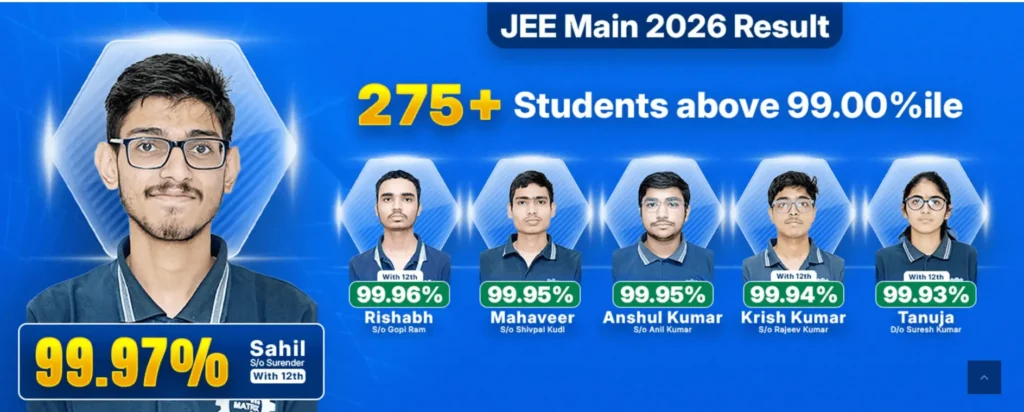
The JEE Main 2026 Session 1 results are out. Matrix JEE Academy delivered outstanding results in JEE Main 2026 Session 1, being the top performer in Sikar. Even if we talk about JEE Main 2026, both sessions, our students outperformed. Year after year, Matrix JEE Academy has been proving its efficiency and standard by delivering exceptional JEE Main results. Let us look at the highlights of Matrix JEE Academy JEE Main 2026 Session 1 results and JEE Main 2025 results:
- 275+ students scored 99 percentile and above in JEE Main 2026 January session, showcasing large-scale academic excellence and not just individual toppers.
- 11 students secured 99.90+ percentile, leading the top ranks in Sikar.
- 30 students scored above 99.80 percentile, and 116 students achieved 99.5+ percentile.
Result highlights of JEE Main 2025:
- 8 students scored above 99.95%ile
- 16 students scored above 99.90%ile
- 35 students scored above 99.80%ile
- 121 students scored above 99.50%ile
- 276 students scored above 99.00%ile
- 2 students achieved 100%ile in Physics
JEE Main 2025 toppers:
- Gaurav Pareek – AIR 238 (99.988%ile)
- Bhavya Modi – AIR 445 (99.976%ile)
- Rishabh Meel – AIR 479 (99.974%ile)
- Sourabh Kumar Soni – AIR 515 (99.972%ile)
- Nishant – AIR 614 (99.965%ile)
- Pranshu Bharia – AIR 681 (99.961%ile)
Result highlights of JEE Main 2024
- 6 students scored above 99.95%ile (Highest in Sikar)
- 15 students scored above 99.90%ile (Highest in Sikar)
- 30 students scored above 99.80%ile (Highest in Sikar)
- 102 students scored above 99.50%ile (Highest in Sikar)
- 231 students scored above 99.00%ile (Highest in Sikar)
- Exceptional performance, with 2 students achieving 100%ile in Physics.
JEE Main 2024 toppers:
- Deepak – AIR 467 (99.98%ile)
- Harsh Lamba – AIR 610 (99.97%ile)
- Akshay – AIR 739 (99.96%ile)
- Harsh Birda – AIR 999 (99.94%ile)
The results highlight Matrix’s structured preparation system, continuous testing, and expert mentorship, ensuring repeatable top results every year. We are positive about JEE Main 2026 Session 2 results.
Last Minute JEE Main Session 2 Preparation Guide by Matrix Academy’s Topper
Matrix JEE Academy, Sikar, has a history of exceptional performance in the JEE Main exam. This is possible because of the research-backed strategies used by Matrix toppers. The highly experienced Matrix faculty has IIT/NIT and top engineering college graduates. Hence, they bring in their expertise, experience and self-tested strategy to make a foolproof study plan for JEE Main. Let us discuss the preparation strategies used by our toppers to crack JEE Main:
- Bhavya Modi (99.97 percentile) stresses mastering the NCERT. He solved every exercise mentioned in the NCERT twice to build accuracy.
- Gaurav Pareek (99.9888 percentile) suggests solving high-quality numericals and questions daily without fail. He used to solve 40-60 mixed physics and maths problems daily.
- Rishabh Meel (AIR 70, JEE Advanced 2025) took weekly tests seriously. He developed a habit of giving the exam as it is real and maintaining an error log to track down his mistakes.
- Nishant & Sumit Kumar (99+ percentile scorers) believe that the habit that sets apart a topper is a structured revision cycle. They revised formulas, coaching notes and PYQs every day.
Along with these strategies, a student who focuses on time management, regular coaching classes and maintains consistency can crack JEE Main 2026. Students are advised to go through the JEE Main Session 1 paper analysis and solve it for better preparation.
Want to learn about JEE Main preparation from class 11? Find out the journey of toppers and the strategic study plan to crack JEE.
Conclusion
With JEE Main 2026 Session 2 just days away, students should focus on revision, PYQs, mock tests and JEE Main 2026 January session shift analysis. Based on Session 1 analysis, a 99 percentile is still achievable with the right last-week strategy. Download your admit card for JEE Main April Session from the official website as the link is live now. This is what sets a topper apart and will help aspirants grab the last chance to crack the JEE Main exam this year in 2026.
The JEE Main 2026 Session 1 is over, and Session 2 will start from 02 April, 2026. The overall difficulty level of the 10 shifts can be said to be moderate and lengthy. Students who are appearing for JEE Main 2026 Session 2 have only one week left now. Students can still improve their score and target 99 percentile by learning tricks on how to crack JEE Main in 30 days and focusing on the topper tips for the last minute. To crack the dream of securing admission in the top-tier engineering institutes, stay consistent with PYQs, mock tests and follow the guidance of your mentors. It is advised to stay updated with NTA notifications to avoid missing important information.
FAQs
Yes, the JEE Main 2026 exam has started for session 1 and has finished on January 29, 2026. The first exam was conducted on 21 January between 9 AM and 12 PM. The exam dates are January 21–29, 2026. The exam date for session 2 is scheduled between April 2 and April 8, 2026.
Candidates can give both sessions for JEE Main 2026. NTA will consider the best score out of both sessions as the final score and percentile.
The JEE Main paper 1 has 75 questions in total. 25 questions each in the physics, chemistry and mathematics sections. It is mandatory to attempt all the questions. +4 marks are allotted for a correct answer, and -1 is the negative marking for a wrong attempt and 0 for an unattempted question.
Candidates must have passed class 10+2 or equivalent examination in the year 2024, 2025, or candidates who are appearing for the class 12 exam in 2026 are eligible. They must have physics, mathematics and chemistry in class 10+2.
Most students prefer to take coaching for the JEE Main exam for a few reasons. Coaching provides a structured study plan, doubt support, great faculty and personal feedback to improve scores. At Matrix, students have observed a drastic improvement in their scores, proving that coaching makes a difference in the JEE journey.
Yes. Droppers can give the JEE Main 2026 until they meet the eligibility criteria. Aspirants are allowed to give 6 attempts in 3 consecutive years; after that, they are not eligible.
NTA releases the official application form correction window to edit any details required. The JEE Main 2026 form correction window is open from December 1, 2025, to December 2, 2025.
Based on the previous year’s cutoffs, the expected cutoff for JEE Main 2026 can be anticipated. The expected cut-off for JEE Main 2026 is around 93-95 percentile for the General category, 80-86%ile for OBC, 60-65 %ile for SC and 48-50 %ile for ST.
Approximately 9 to 15 lakh students register for the JEE Main exam every year. For JEE Main 2026, the registrations have reached 14.5 lakh candidates, indicating an increase in registrations.
You can check exam analysis of all the shifts on JEE Main session 1 exam from the links provided below:
JEE Main Session 1 Paper Analysis (All Shifts)(Live Now)
JEE Main Session 1 Paper Analysis (21 January Shift 1)(Live Now)
JEE Main Session 1 Paper Analysis (21 January Shift 2) (Live Now)
JEE Main Session 1 Paper Analysis (22 January Shift 1) (Live Now)
JEE Main Session 1 Paper Analysis (22 January Shift 2) (Live Now)
JEE Main Session 1 Paper Analysis (23 January Shift 1) (Live Now)
JEE Main Session 1 Paper Analysis (23 January Shift 2) (Live Now)
JEE Main Session 1 Paper Analysis (24 January Shift 1) (Live Now)
JEE Main Session 1 Paper Analysis (24 January Shift 2) (Live Now)
JEE Main Session 1 Paper Analysis (28 January Shift 1) (Live Now)
JEE Main Session 1 Paper Analysis (28 January Shift 2) (Live Now)
JEE Main Session 1 Paper Analysis (29 January Shift 1)(Live Now)
NTA released the provisional answer key officially on the website on 4th February, 2026. Students can also raise objections based on the official answer key until the 6th of February, 2026. within a few days after the exam. Candidates can download it from the official JEE Main website and calculate their expected score before the result.
The JEE Main All India Rank (AIR) is calculated based on the final official percentile and NTA score after the normalisation process across shifts. NTA prepares a merit list using the best score out of both sessions. Candidates can find out their AIR based on their score.
JoSAA counselling usually begins after both sessions of JEE Main are over and the JEE Advanced results are announced. Registration is expected to start around June 2026.
The admit card for JEE Main 2026 Session 2 was released on March 29, 2026 and April 1, 2026. The download link for all exam dates is active now. by the National Testing Agency. Candidates can download it from the official website using their application number and password. It is advised to download the admit card as soon as it is released to avoid last-minute issues.