


Physical Chemistry Chapters for NEET UG 2026
NEET Physical Chemistry chapters carry more than 30% weightage of the Chemistry section in the exam. Physical Chemistry is often referred to as a difficult part of the Chemistry syllabus. The primary reason behind this is that Physical Chemistry demands strong knowledge of fundamental concepts, abstract-based theories, proficiency in complex numerical problem-solving, conceptual depths, and a high level of accuracy to eliminate errors.
Completing NEET Physical Chemistry chapters is challenging for students, which is why they often feel that this Chemistry subject is as difficult as climbing a mountain. At Matrix Academy, we climb this mountain in a step-by-step process by placing the right step at the right time to ensure constant growth. Matrix teaches Physical Chemistry with conceptual clarity, rigorous problem-solving approach, personalised strategies, and expert faculty guidance. In relation to this, the blog will conduct a deep analysis by breaking down the Physical Chemistry chapters, their importance, and the Matrix suggested preparation strategies to score well in the subject of Chemistry.

NEET Physical Chemistry Syllabus Overview by Narendra Bissu Sir (Physical Chemistry Faculty, Matrix Academy)
For effective NEET Physical Chemistry preparation, it is important to analyse the syllabus defined by NTA (National Testing Agency). Through conducting a deep discussion with Matrix Academy Physical Chemistry expert educator Narendra Bissu Sir, we identified 8 core chapters.

The identified 8 Physical Chemistry chapters are as follows-
- Some Basic Concepts of Chemistry
- Atomic Structure
- Chemical Bonding and Molecular Structure
- Chemical Thermodynamics
- Solutions
- Equilibrium
- Redox Reactions and Electrochemistry
- Chemical Kinetics
NEET Physical Chemistry contributes approximately 30-33% of the total Chemistry section. For example, Chemical Bonding and Molecular Structure weightage is approximately 7%, Solutions around 5%, Electrochemistry 5%, Thermodynamics 4%, and Chemical Kinetics 4%.
This clearly shows that Physical Chemistry section of NEET exam is not only a subject with heavy-level numerical, but it also demands a perfect combination of conceptual understanding and problem-solving skills. You should maintain a proper preparation balance by focusing both on rigorous theory and consistent practice, which is essential to studying this Chemistry subject effectively.
Chapter-wise Breakdown of NEET Physical Chemistry
The following table offers a clear breakdown of the Physical Chemistry chapters by considering the most important topics for the upcoming NEET UG 2026 exam.
| Chapter (Unit Wise) | Approximate Weightage / Importance | Key Topics & Why They are Important |
| Some Basic Concepts of Chemistry | Small but foundational (1–2 %) | Mole concept, Stoichiometry, Empirical formula, Molecular Formula, Chemical Equations, Laws of Chemical Combination. All of these fundamental topics help in creating a strong base for calculations in other chapters. |
| Atomic Structure | Moderate with Conceptual importance- 2 % | Atomic Models (Bohr, Dalton’s, and Rutherford’s models), Quantum Mechanics, Quantum Numbers, Electron Configurations- Aufbau Principle, Hund’s rule, and Pauli’s exclusion principle. By effectively covering these topics, you can develop an understanding of Hybridisation and Bonding. |
| Chemical Bonding & Molecular Structure | High- 7 % | Ionic vs Covalent bonding, VSEPR theory, Hybridisation, Resonance, Molecular Orbital Theory (MOT), Bond Order, Bond Energy, Hydrogen Bonding. This chapter is considered high scoring because it frequently appears in the NEET exam by combining theory + moderate numerical. |
| Chemical Thermodynamics | Moderate- 4% | 1st, 2nd, and 3rd laws of Thermodynamics, Internal energy, Enthalpy, Entropy, Gibbs free Energy, Spontaneous Processes, Hess’s law. A clear understanding of Spontaneity (ΔG) and Equilibrium (ΔG°) is crucial for solving Equilibrium problems. |
| Solutions | Moderate- 5% | Concentration units (molarity, molality, mole fraction), Raoult’s Law, Ideal & Non-Ideal Solutions, Colligative Properties (Boiling point elevation, freezing point depression, osmotic pressure), Van’t Hoff factor. All of these numerical are high-weightage topics. |
| Equilibrium | Important (Part of 11th Class) | Chemical Equilibrium Concepts (Kc, Kp), Le Chatelier’s Principle, Relationship between ΔG and Equilibrium Constant, Ionic Equilibrium (Acid–Base, pH, Buffers, Solubility Product), Common-ion Effect. Mastering these topics helps in covering both theoretical and Application-based questions. |
| Redox Reactions & Electrochemistry | High- 5% | Oxidation-Reduction Concepts, Balancing Redox Equations, Electrochemical Cells, Nernst Equation, Electrode Potentials, Conductance, Cell Potential EMF, Gibbs Energy Relation. All of these topics combine conceptual depth and calculation-based questions. |
| Chemical Kinetics | Moderate- 4% | Rate of Reaction, Factors Affecting Rate, Order and Molecularity, Rate Laws, Zero and First-Order Kinetics, Arrhenius Equation, Activation Energy, Collision Theory. These are primarily numerical chapters. |
Important Chapters & Topics to Consider
All the above-mentioned chapters and topics are important while covering NEET Physical Chemistry, but the following are some top important chapters with their topics as follows-
- Chemical Bonding & Molecular Structure: Given its high weightage and mix of theory and application, this is one of the most strategically important chapters.
- Redox Reactions & Electrochemistry: High scoring due to standard problems related to the Nernst equation, electrode potentials, and conductance.
- Solutions: NEET frequently tests colligative properties, so it is important to master the Van’t Hoff factor and Raoult’s law.
- Chemical Thermodynamics: This chapter is important due to topics like enthalpy, entropy, Gibbs free energy, and spontaneity.
- Chemical Kinetics: Reaction-order problems, half-life, and Arrhenius plots are common and predictable under this chapter.
- Equilibrium: The chapter includes important topics like acid–base equilibrium, Buffer solutions, and Solubility Product Problems. All these are valuable for both concept and number-based questions.
Essential Preparation Strategies by Matrix Academy
At Matrix Academy, our primary focus is on teaching Physical Chemistry in a systematic and student-centric manner. The study methodology is based on breaking down complex topics into basic concepts. The following are some suggested preparation strategies for NEET Physical Chemistry by Narendra Bissu Sir, as follows, based on improving conceptual clarity and exam performance-

1. Concept-Building Modules
At Matrix, our Chemistry teaching team develops conceptual modules for our students. Our students attend theory-based classes with interactive lectures, designs, and real-world examples. After creating a base from the theoretical portion, students attend numerical practical sessions. For Thermodynamics, Narendra Sir teaches our students to understand spontaneity and entropy using visual diagrams (for example, disorder in a room) before introducing difficult topics like Gibbs Energy Equations. This unique approach supports creating a system where our students learn this subject with a strong conceptual foundation, which in turn helps them solve complex numerical problems more efficiently and with minimal scope for error.
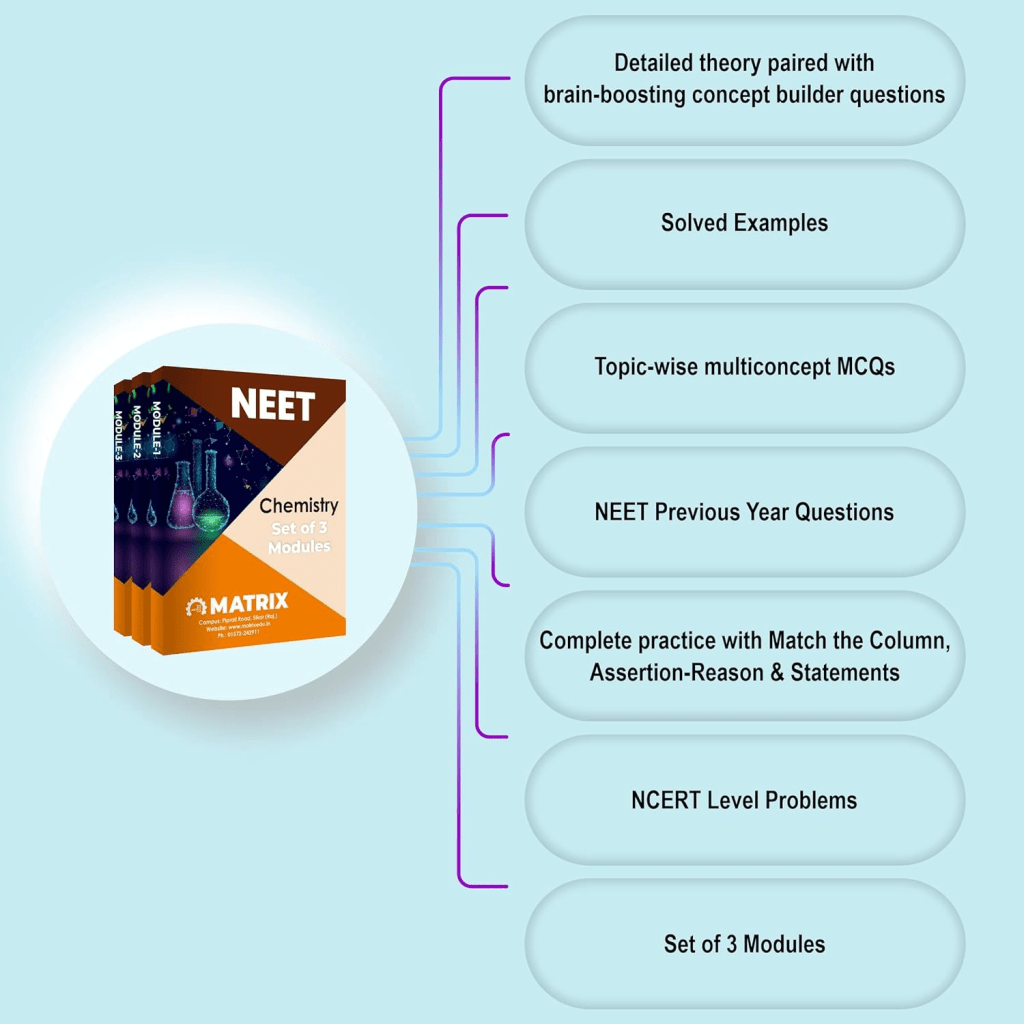
Matrix designs a unique template sheet to solve calculation-based numerical problems, such as thermodynamics, kinetics, and equilibrium. The template is based on a framework for students to systematically apply concepts and handle questions step-by-step. You can regularly practice these templates every week under the supervision of expert educators to improve your weak areas.
2. Incremental Problem Sets for Questions
Instead of putting pressure on students to attempt various high-difficulty questions at a time, we teach our students with a 3-tier problem set strategy as follows-
- Level 1 (basic NCERT-style)
- Level 2 (intermediate challenging)
- Level 3 (advanced level application)
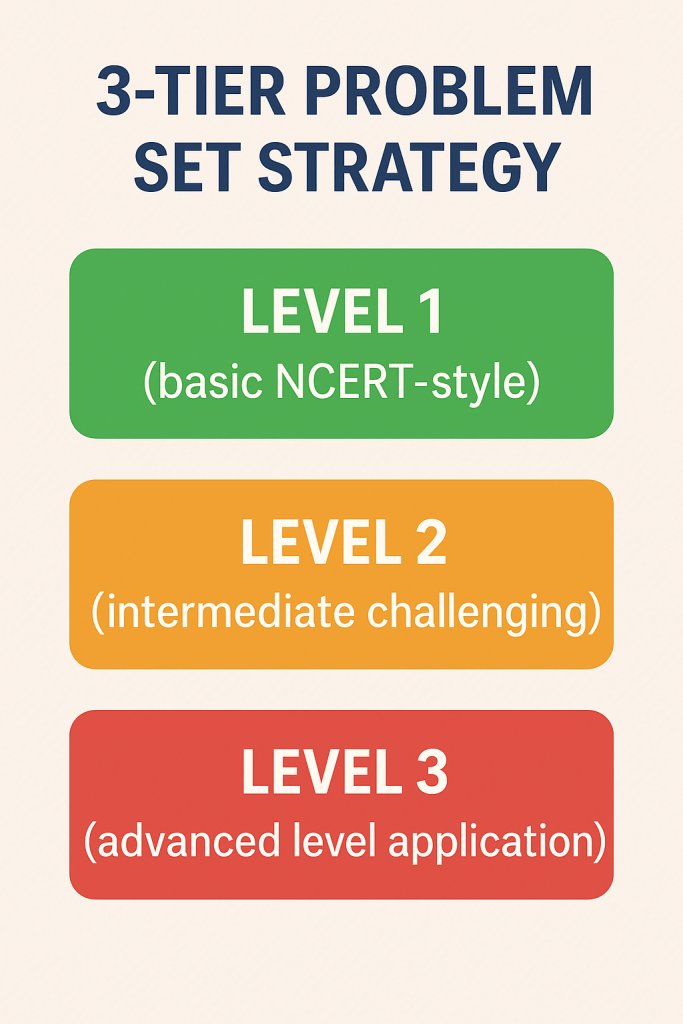
From a foundational base, you can gradually work on building concept application under expert supervision to build confidence for the final NEET exam. This approach also helps in improving your mock test results because you have already practised numerous questions of the relevant problems.
3. Integrated Mock-Tests & Performance Breakdown Approach
Matrix Academy’s approach to attempting NEET mock tests smartly starts with pre-test strategic planning by setting realistic goals before each test. Matrix Academy conducts regular weekly/monthly mock tests with the belief that their results work as a diagnostic tool, helping in increasing problem-solving skills to get familiar with the real exam environment. At Matrix, we conduct mini mock tests on a weekly and monthly basis to simulate the NEET exam style, time pressure and mix of numerical and theory-based questions. Matrix Physical Chemistry test series offers 25+ different analyses for Chemistry, based on different types of question levels.

Our performance breakdown approach helps in breaking down difficult topics. For example, if a student is continuously facing challenges with difficult topics like the Nernst equation or Le Chatelier’s principle, then our educators organise remedial session classes to suggest easy and practical tips to master these topics. This mechanism helps in creating a complete system for the NEET students by ensuring you have a strong understanding of difficult topics.
4. Doubt–Resolution Counters for Physical Chemistry
Doubt-clearing sessions are one of the most important advantages of Matrix Academy for teaching Physical Chemistry. These doubt-clearing sessions are well-structured and organised with small-group sessions, where students bring their toughest conceptual or calculation problems. Matrix expert faculty break down each question line by line, by teaching alternate methods (e.g., graphical vs algebraic solutions for kinetics) to the students, so they can find the best way to answer them. This approach strengthens both understanding and speed to solve advanced-level questions.

5. Periodic Revision Sessions
Matrix Academy also design monthly revision sessions, based on a structured, multi-pronged approach that develops core conceptual clarity and application-based problem solving approach with specialised tools like problem templates and timed practice sessions. These revision sessions cover the Physical Chemistry chapters briefly, with the focus on the top-most common NEET numerical and concepts, and revisiting tricky subtopics.
To align with the student perspective, our 1-Year Integrated NEET foundation program is especially designed with a highly useful collection of questions for NEET preparation. This program combines full-length NEET Chemistry simulations that integrate all three chemistry sections (physical, organic, inorganic). After the completion of each test, our teachers conduct a planning session, where faculty review common issues (for example, misuse of sign-in thermodynamics) by offering personalised revision roadmaps to strengthen the NEET Physical preparation journey. This program also helps in ensuring that students are exam-ready and mentally prepared for physical chemistry questions under real NEET exam conditions.
Common Mistakes & How to Avoid Them While Studying NEET Physical Chemistry
To cover the above-mentioned NEET Physical Chemistry chapters, it is important to avoid some common mistakes to score well in this area of Chemistry. The following are some common mistakes and ways to avoid them, suggested by Matrix Academy expert educators.
- Relying too much on memorisation: Most of the NEET aspirants focus on memorising the definitions and formulas without understanding the process to apply them. At Matrix Academy, our focus is on developing conceptual clarity first and then its application, so you can logically apply it in solving numerical problems.
- Skipping NCERT Examples: Students have a mindset that Physical Chemistry is a numerically based subject and can be solved with only advanced-level study materials. At Matrix, we teach our students with NCERT core books to create a foundational base for conceptual clarity and then offer them coaching-level problem sets for advanced-level questions.
- Overlooking Chemistry Theory: Practising Physical Chemistry problems is important to solve numerical problems, but always remember that theory (derivations or conceptual justification) teaches the approach to solve any numerical problems. Matrix-designed formula booklet and concept modules are especially designed with clear and in-depth explanations of fundamental concepts to ensure a strong understanding before moving to calculations.
- Ignoring Time Management: Time management is an important aspect in solving Physical Chemistry, where you should practice avoiding arithmetic errors to improve your performance in solving numerical questions. Matrix numerical revision classes help students to become fast and accurate in solving complex problems.
- Doubt Accumulation: Students generally prefer solving doubts related to numerical problems in the end, which creates a negative impact on their step-by-step preparation journey. Matrix effectively organises doubt-clearing workshops and expert assistance to ensure that doubts are addressed continuously by leaving enough time for their revision.
The implementation of a strategic approach to prepare NEET Chemistry helps in building proficiency with resilience and confidence.
Useful Resources to Prepare for NEET Physical Chemistry
Matrix Academy suggested essential study resources for NEET Physical Chemistry are as follows-
- NCERT Chemistry (11th & 12th) to study core theory.
- Matrix Academy Matrix online test & video library for conceptual clarity.
- Physical Chemistry problem book (for example, OP Tandon or Matrix designed NEET PYQs) for practice.
- You can also maintain a separate formula sheet book for physical constants, laws, and equations to revise during mocks.
Conclusion
Physical Chemistry is not a difficult subject if you study with a clear syllabus roadmap, chapter-wise priority, and the right strategies. The most important chapters in NEET Physical Chemistry are Bonding, Electrochemistry, and Solutions, where you can take advantage of the Matrix Academy’s structured modules, problem sets, and feedback loops to master both theory and numerical. The preparation must be based on the implementation of facts, practising the NCERT, doubt-solving approach, and time management. By implementing a personalised strategy and consistency, you can score well in Physical Chemistry in the upcoming NEET UG 2026 exam.
FAQs
As per Matrix NEET Chemistry faculty Narendra Bissu Sir, NEET Physical Chemistry is mainly divided into 8 major chapters, such as Mole Concept, Atomic Structure, Chemical Bonding, Thermodynamics, Solutions, Equilibrium, Electrochemistry, and Chemical Kinetics. All these chapters are necessary for the conceptual and numerical foundation of NEET Physical Chemistry.
The highest weightage subjects in NEET Physical Chemistry are Solutions, Chemical Bonding, Kinetics, and Thermodynamics. Most of the scoring questions in NEET Physical Chemistry are from these chapters, which makes them highly important for maximising marks in NEET.
Students face issues in NEET Physical Chemistry because they lack conceptual clarity and enough theoretical knowledge to solve numerical problems. You can solve this issue with practical strategies suggested by Matrix Academy for proper guidance and a balanced theory approach.
You can take assistance from the Matrix Academy NEET Physical Chemistry study approach, based on conceptual clarity, by using interactive theory lectures, visual analogies, and structured numerical modules. Your focus should be on building a strong foundation, then applying it to solve advanced-level problems.
You can use the Matrix Academy-designed 3-level strategy: Level 1 (basic), Level 2 (intermediate), and Level 3 (advanced) question sets. This step-by-step preparation approach helps strengthen application-based skills by boosting confidence in actual NEET exam questions.
According to Matrix Academy, some common mistakes made while studying NEET Physical Chemistry include a lack of understanding of concepts, skipping NCERT theory, delaying doubt-solving, and poor time management. A consistency in practice with conceptual clarity helps in improving accuracy and performance gradually for the upcoming NEET UG 2026 exam.



![Updated NEET Exam 2026 Syllabus [Released by NTA!!] Download PDF](https://www.mycareer.matrixedu.in/wp-content/uploads/2025/12/Updated-NEET-Exam-2026-Syllabus-Released-by-NTA-Download-PDF-256x256.webp)