


Career Options After MBBS in India: Courses, Jobs, and Future Opportunities
Career Options After MBBS in India: Courses, Jobs, and Future Opportunities
As the holder of an MBBS degree, you can practice at a traditional clinic or explore diverse career options after MBBS. While clinical practice is the conventional route, many aspirants consider higher studies, research, healthcare administration, and non-clinical jobs for better opportunities. Choosing the right career path involves aligning your passion and skills to make a meaningful impact in the medical field. This comprehensive guide will explore the myriad of post-MBBS career options, courses, and opportunities in detail, helping you make an informed decision about your future.
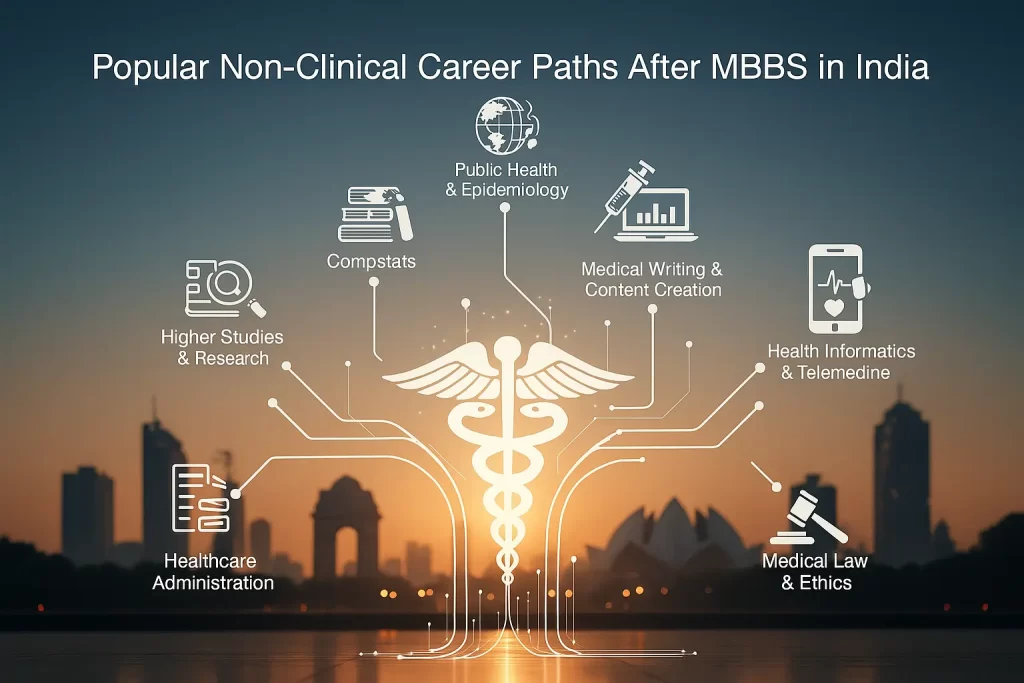

Career Opportunities After MBBS: What’s Next?
Clearing NEET and completing an MBBS program is a significant achievement. The course spans nearly five years, and as you near graduation, the big question arises: What are the best career options after MBBS?
The good news? Today’s MBBS graduates have more opportunities than ever. You can choose postgraduate medical courses, hospital management, medical research, healthcare startups, or international medical careers. In this blog, we’ll explore these post-MBBS career options in detail and guide you toward the best path after MBBS.
In this blog, we’ll discuss such opportunities in detail and help you clearly understand your career options after NEET.
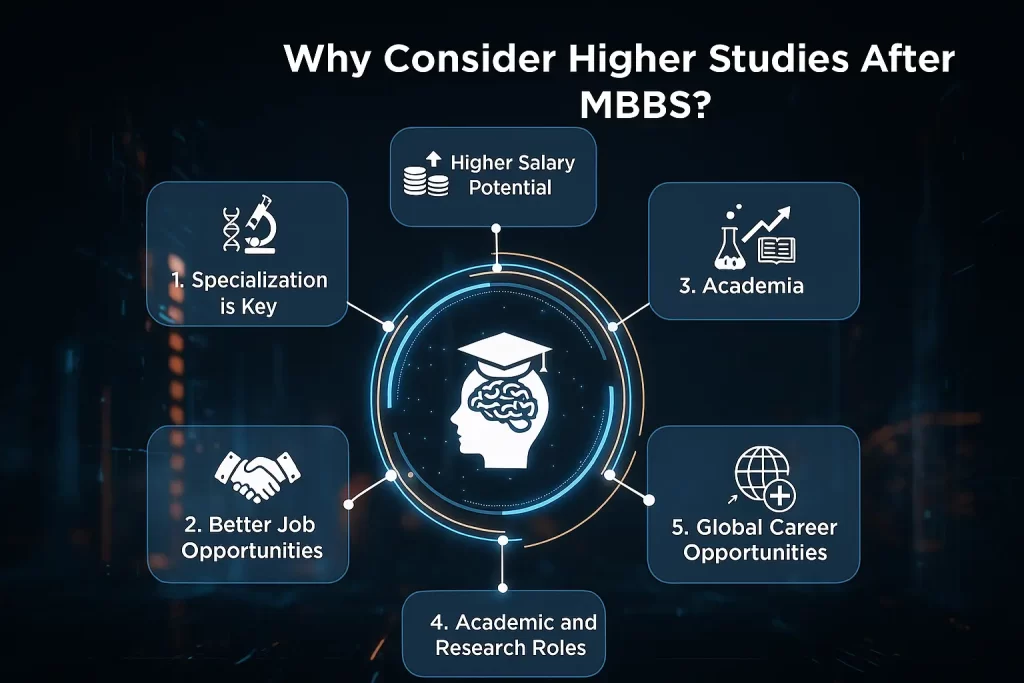
Why Consider Higher Studies After MBBS in India?
Many MBBS graduates aim for higher studies because it offers significant advantages:

- Specialization is Key: Patients increasingly seek specialized doctors for specific treatments, making specialization crucial for career growth.
- Better Job Opportunities: Doctors with postgraduate qualifications are often preferred for senior roles in hospitals and clinics.
- Higher Salary Potential: Specialists and super-specialists consistently earn higher incomes than general practitioners.
- Academic and Research Roles: Additional qualifications are essential if you aspire to teach or conduct medical research.
- Global Career Opportunities: Postgraduate degrees are often a prerequisite for practicing medicine in many countries abroad.
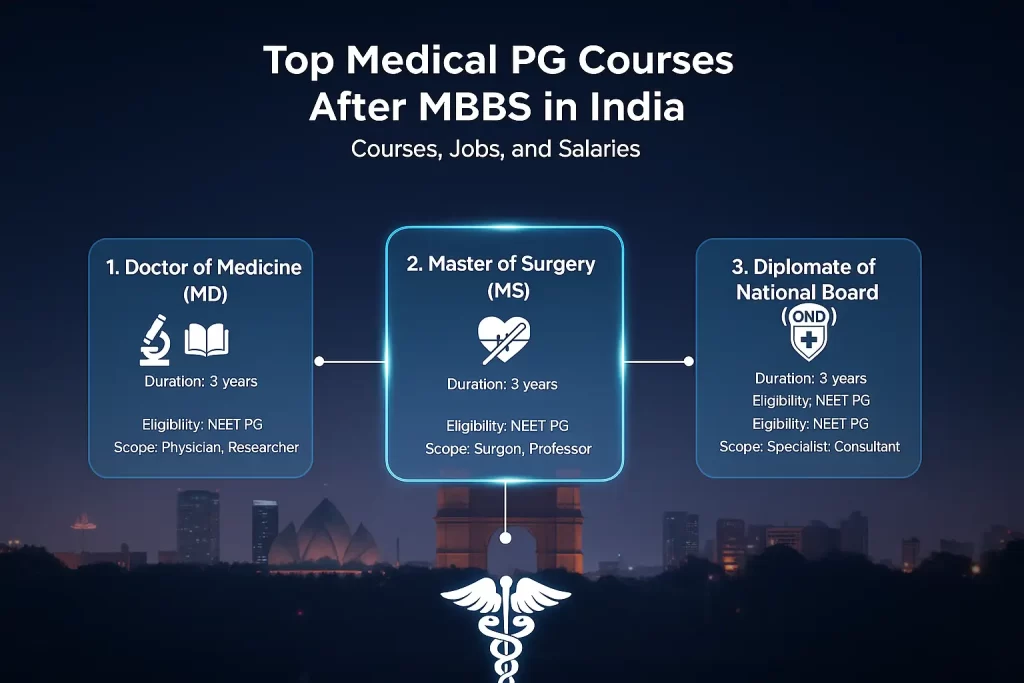
Top Medical PG Courses After MBBS in India
The most common and impactful path after MBBS is pursuing a postgraduate medical degree. These 3-year programs provide in-depth specialization.
1. Doctor of Medicine (MD)
- Duration: 3 years
- Eligibility: Must clear the NEET PG exam.
- Top Specializations: General Medicine, Pediatrics, Radiodiagnosis, Dermatology, Psychiatry, Anesthesiology.
- Career Scope: Hospital consultant, teaching, research, private practice.
2. Master of Surgery (MS)
- Duration: 3 years
- Eligibility: Must clear the NEET PG exam.
- Top Specializations: General Surgery, Orthopedics, ENT (Ear, Nose, Throat), Ophthalmology, Obstetrics & Gynecology.
- Career Scope: Surgeon, senior resident, hospital consultant, professor.
3. Diplomate of National Board (DNB)
- Duration: 3 years
- Eligibility: Must clear the NEET PG exam.
- Conducted by: National Board of Examinations (NBE).
- Equivalence: Considered equivalent to MD/MS degrees and is accepted in both government and private hospitals.
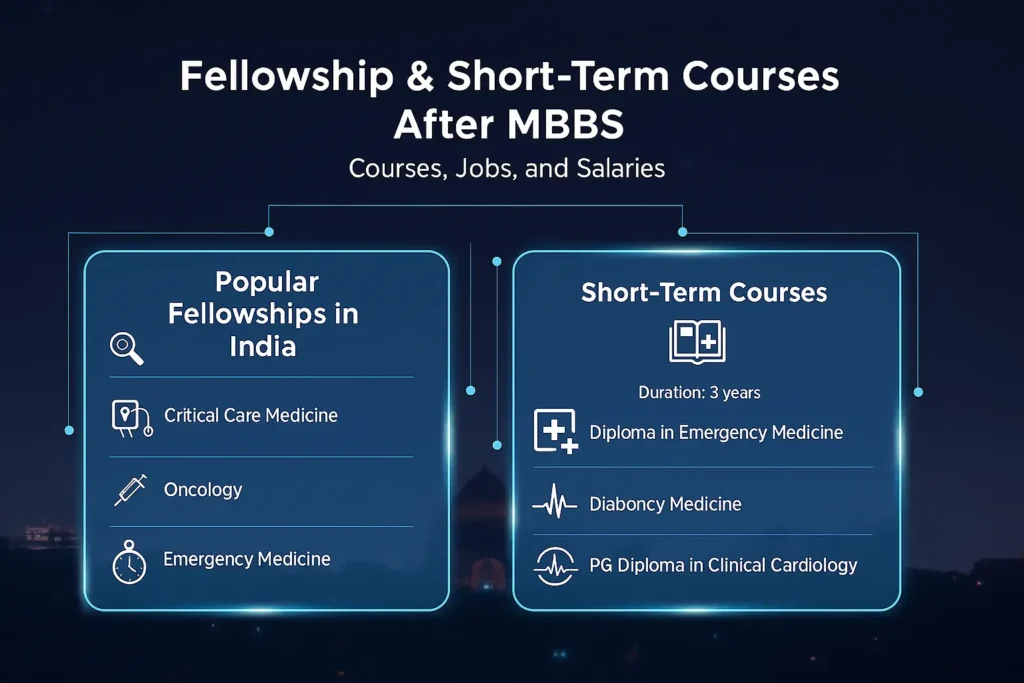
Fellowship and Short-Term Courses After MBBS
For those who want to gain specialized skills quickly, fellowships and short-term courses are a great choice. They offer hands-on experience without the full commitment of a 3-year PG program.
- Popular Fellowships in India: Fellowship in Critical Care Medicine, Diabetology, Oncology, Emergency Medicine, and Cosmetic Dermatology.
- Short-Term Courses: Diploma in Emergency Medicine, PG Diploma in Clinical Cardiology, Certificate Course in Medical Coding.
Non-Clinical and Alternative Career Options After MBBS
If traditional clinical practice isn’t your preference, your MBBS degree opens doors to many innovative and impactful non-clinical roles.
- Hospital Administration and Management: Manage hospital operations, staff, and budgets. An MBA in Hospital and Healthcare Management is highly recommended.
- Public Health Services: Work with government health departments, NGOs, or international organizations like the WHO to lead public health campaigns. An MPH (Master of Public Health) is ideal.
- Medical Writing and Journalism: Use your medical knowledge to simplify complex health information for medical journals, health blogs, or pharmaceutical companies.
- Healthcare Technology (HealthTech): Work with startups to develop medical apps, devices, or software that enhance healthcare delivery.
- Pharmaceutical Industry: Roles include Medical Advisor, Clinical Trial Manager, or Drug Safety Officer.
- Medico-Legal Advisor: Combine medical expertise with legal knowledge to assist in medical litigation and forensic investigations.
- Entrepreneurship: Start your own healthcare business, wellness center, or telemedicine platform.
Courses Abroad and International Opportunities
For those aiming for international practice or global exposure, pursuing courses abroad after MBBS can be transformative.
- USMLE (United States Medical Licensing Examination): The path for practicing medicine in the U.S. It involves multi-stage exams and a residency program.
- PLAB (Professional and Linguistic Assessments Board – UK): The exam required by the General Medical Council (GMC) to practice in the UK.
- Other Exams: AMC for Australia and MCCQE for Canada.
- Research-Based PG Courses Abroad: MSc in Clinical Research, Masters in Global Health, and Masters in Health Administration.
Government Jobs and Academic Careers After MBBS
If you’re looking for stable employment and a chance to serve the community, government jobs and academic roles are excellent options.
Government Jobs in India
- Medical Officer: Work in state or central hospitals.
- Community Health Officer (CHO): Work in rural health centers under the National Health Mission (NHM).
- UPSC Combined Medical Services (CMS) Officer: Roles in Railways, Armed Forces Medical Services (AFMS), and ESIC.
- Army Medical Corps: Serve as a doctor in the Indian Armed Forces.
Career in Research and Academia
- PhD in Medical Sciences: Requires an MD/MS degree and leads to roles as a research scientist or lab head.
- Medical Teaching: Join as an Assistant Professor in a medical college after completing your PG degree.
Future Outlook: The Road Ahead for MBBS Doctors in India
The future for MBBS graduates in India remains exceptionally bright, with a continuously increasing demand for skilled medical professionals. Your MBBS degree provides a robust foundation for a fulfilling and impactful career, no matter which path you choose.
Final Thoughts: Your Path, Your Choice
Your MBBS degree is just the beginning of a profound journey. The key to a successful and satisfying career lies in understanding your interests, strengths, and long-term goals. Explore all the career options after MBBS in India, weigh the pros and cons, and make a well-informed decision that aligns perfectly with your aspirations.
FAQ
- How many career options after MBBS are there?
- Clinical practice
- Hospital administration
- Research
- Public health services
- Medical writing
- Healthcare technology,
- Non-clinical roles
- What is the best career option after MBBS?
You can pursue clinical practice, hospital administration, research, medical writing, healthcare technology, or global health opportunities. - What is the average starting salary for an MBBS doctor in India?
The average starting salary for a fresh MBBS graduate in India typically ranges from ₹40,000 to ₹70,000 per month in private setups and ₹60,000 to ₹80,000 per month in government hospitals, varying by location and institution. - Is studying abroad after MBBS worth it?
It can be very rewarding for those seeking global recognition, higher pay, and exposure to advanced systems. However, it involves high costs, competitive exams (like USMLE, PLAB), and significant adaptation challenges. It’s worth it for ambitious individuals prepared for the rigorous process. - What is the difference between an MD and an MS degree?
An MD is a 3-year postgraduate degree for non-surgical specializations (e.g., General Medicine), while an MS is a 3-year program for surgical specializations (e.g., General Surgery). Both require clearing the NEET PG exam. - Can I get a non-clinical job right after MBBS?
Yes, while clinical experience is often preferred, you can pursue non-clinical roles immediately after MBBS in areas like medical writing, healthcare technology startups, or entry-level positions in the pharmaceutical industry. - How important is the NEET PG exam for my career after MBBS?
The NEET PG exam is crucial if you aim to pursue a postgraduate specialization (MD/MS/DNB) in India. It is the primary gateway to gaining admission, which is essential for becoming a specialist and significantly increasing your earning potential.